
HER1: How Crete is Becoming a Data Centre Connectivity Hub
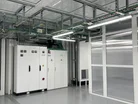
In April 2025, Data Centre Magazine visited HER1, the first carrier-neutral data centre in Crete.
Built by Digital Realty, the company is eager to transform connectivity in the Mediterranean and revolutionise sustainable data centre design. Significantly, the build features Schneider Electric prefabricated solutions, which ensured the facility was built quickly and sustainably.
As data demand continues to surge, with data exchange growing at a rate of 30% each year, Digital Realty’s customers now want a better solution for distributing content to the Mediterranean region.
“There is room for something more efficient in the East Mediterranean,” shares Fabrice Coquio, Managing Director for Digital Realty France. “Digital Realty has deployed strategy all along the Mediterranean – including Barcelona, Rome, Athens and Tel Aviv – so that we can support our customers in dealing with submarkets or subregions more effectively.”
Tackling European demand
Digital Realty has been investing in European data centre expansion in recent years and now turns its attention to Heraklion in Crete – which it believes to be a new hub for connectivity.
“We realised the subsea cable industry was changing drastically and very quickly,” Fabrice says. “Creating the foundation of HER1 requires a correct, well-positioned foundation of subsea cables, terrestrial cables and satellite communications. The more data you’ve got, the more connectivity players you will have.”
Although he took on his current role in March 2025, Pablo Ruiz Escribano, Senior Vice President, Secure Power and Data Center Business at Schneider Electric, Europe, has already started to see the opportunities and challenges of the Greek data centre market.
“Some markets in Europe are saturated and so Tier 2 markets are starting to expand, including Greece,” he explains. “Appetite for renewables is also really concentrated. Although the demand in the FLAP-D markets is still there, Tier 2 markets are currently growing faster – which leaves room for constraints like a lack of talent across Europe to manage new and fast-expanding infrastructure.”
One of the things Digital Realty has prioritised when investing in HER1 is the local community, engaging with local programmes and initiatives and working with Greek authorities to engage all people living within the region.
“We are not building something for the weekend or for a holiday – we are building infrastructure,” Fabrice says. “This is a long-term investment for us.”
In April 2025, Data Centre Magazine visited HER1, the first carrier-neutral data centre in Crete.
Built by Digital Realty, the company is eager to transform connectivity in the Mediterranean and revolutionise sustainable data centre design. Significantly, the build features Schneider Electric prefabricated solutions, which ensured the facility was built quickly and sustainably.
As data demand continues to surge, with data exchange growing at a rate of 30% each year, Digital Realty’s customers now want a better solution for distributing content to the Mediterranean region.
“There is room for something more efficient in the East Mediterranean,” shares Fabrice Coquio, Managing Director for Digital Realty France. “Digital Realty has deployed strategy all along the Mediterranean – including Barcelona, Rome, Athens and Tel Aviv – so that we can support our customers in dealing with submarkets or subregions more effectively.”
Tackling European demand
Digital Realty has been investing in European data centre expansion in recent years and now turns its attention to Heraklion in Crete – which it believes to be a new hub for connectivity.
“We realised the subsea cable industry was changing drastically and very quickly,” Fabrice says. “Creating the foundation of HER1 requires a correct, well-positioned foundation of subsea cables, terrestrial cables and satellite communications. The more data you’ve got, the more connectivity players you will have.”
Although he took on his current role in March 2025, Pablo Ruiz Escribano, Senior Vice President, Secure Power and Data Center Business at Schneider Electric, Europe, has already started to see the opportunities and challenges of the Greek data centre market.
“Some markets in Europe are saturated and so Tier 2 markets are starting to expand, including Greece,” he explains. “Appetite for renewables is also really concentrated. Although the demand in the FLAP-D markets is still there, Tier 2 markets are currently growing faster – which leaves room for constraints like a lack of talent across Europe to manage new and fast-expanding infrastructure.”
One of the things Digital Realty has prioritised when investing in HER1 is the local community, engaging with local programmes and initiatives and working with Greek authorities to engage all people living within the region.
“We are not building something for the weekend or for a holiday – we are building infrastructure,” Fabrice says. “This is a long-term investment for us.”
Leading by sustainable design
To make HER1 ready in 12 months, from the decision being made to service launch date, Schneider Electric’s prefabricated modular systems were used to save time, money and the carbon impact of the manufacturing process.
Schneider Electric prides itself on collaborating with partners and customers to finalise the design of these modules to optimise manufacturing processes and reduce lead times.
“You can optimise how you manufacture, build and assemble the data centre,” Pablo says. “In the end, it's a better quality with fewer unexpected issues during construction, resulting in a better return on investment because you're able to shorten the time to availability of the entire data centre.”
Schneider Electric also recognises that speed is essential and its prefabricated solutions at HER1 are a testament to that. Pablo credits the company’s acquisition of Motivair to support high-density applications like AI within the data centre.
“Motivair has been working on high-density industrial applications for more than 10 years,” he explains. “Combined with our existing capabilities, we can offer a very large portfolio of solutions that can fit both the traditional use cases we're seeing deployed in the market and the new ones linked to AI.
“In the end, we have a full, holistic and comprehensive portfolio of products and solutions that can support any kind of IT infrastructure deployment, whether for AI or non-AI use cases.”
Fabrice adds: “We discovered this was a very efficient way of reducing our Scope 3 impact. We have a long partnership with Schneider Electric, which makes projects like this easier.”
With HER1, Schneider Electric has prioritised its long-term sustainability strategy, which it integrates across all its operations. The company has already secured 1.5GW of renewable energy for Digital Realty to help define its sustainability strategy.
“We've been able to customise the design of Digital Realty’s data centres based on our products and tools,” Pablo explains. “Facing these challenges together enables them to become a more sustainable company.”
The future of global connectivity
Facilities like HER1 have the potential to improve global connectivity, with Schneider Electric and Digital Realty laying emphasis on the resiliency of submarine cables.
“These facilities are needed and, as more growing or populated countries adopt technology, facilities like HER1 help to increase the mesh of submarine cables needed to make global cable networks more resilient,” Pablo notes. “The fact that we are in the Mediterranean area, connecting Europe with Asia, the Middle East and Africa, makes Greece a key geopolitical area for the future.
“Having more possibilities like HER1 will improve connectivity.”
To read the full article in the magazine, click HERE.
Explore the latest edition of Data Centre Magazine and be part of the conversation at our global conference series, Tech & AI LIVE.
Discover all our upcoming events and secure your tickets today.
Subscribe to our Weekly Newsletter for the latest insights, trends and expert analysis.
Data Centre Magazine is a BizClik brand