
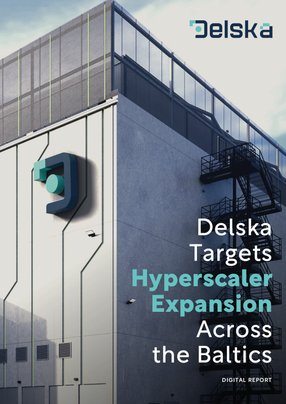
Delska Targets Hyperscaler Expansion Across the Baltics
The Baltic data centre market is transforming as regional operators position themselves to capture growing demand from global hyperscalers and AI workloads.
Leading this change is Delska, a newly unified infrastructure group born from the merger of established Latvian and Lithuanian companies, now operating facilities and networks spanning from the Baltics to Frankfurt.
At the helm is Chief Executive Andris Gailitis, a 30-year industry veteran who witnessed the birth of the commercial Internet in the region.
Starting as a university technician in 1999, when Internet access was largely restricted to academic institutions and wealthy corporations, he has guided the company through decades of technological evolution and today his approach remains focused on core infrastructure rather than chasing software trends.
“We are a pure infrastructure player, and we are doing the best with a deep expertise in the data centres and network field,” says Andris.
This infrastructure-first strategy has proved prescient. Data centres no longer just support business functions but have become critical infrastructure, with technology services now ranking alongside traditional industries in importance.
“When we started, IT technologies were helping other industries,” explains Andris. “Now IT is becoming, in most countries, a critical industry itself: the same as hospitals, the same as banks. If someone completely stopped the communications and data centre industries, it would mean a major crisis for modern society.”
The company’s evolution accelerated through strategic acquisition by Quaero European Infrastructure Fund II and consolidation of a group of companies under the new brand Delska. In 2024, Delska initiated a rebranding process, combining Latvian data centre operator DEAC and Lithuanian Data Logistics Centre (DLC), integrating Lithuanian RackRay a year later to form a comprehensive regional data centre and network infrastructure provider.
“By merging expertise and IT teams, we’ve evolved and broadened our spectrum of portfolio to become a one-stop provider for customers’ IT infrastructure, encompassing cloud services, server rental, colocation, security, including disaster recovery and backup, network solutions and managed services, which sets us apart from pure colocation providers,” explains Delska Chief Marketing Officer Maria Bergere.
The companies that formed Delska have operated in the region for 26 years, providing industry expertise, including knowledge of local regulations and business practices that newer competitors lack.
“What sets us apart is not just our technology but our more than 26 years of experience, enabling us to offer more than infrastructure,” says Maria. “We provide hands-on expertise for daily administration, monitoring and maintenance, backed by SLAs that guarantee uptime and reliability.”
Delska completes Riga facility with multimillion investment and modular AI design
Delska’s new Riga facility addresses a problem facing every data centre operator: nobody knows how much power AI applications will need. Traditional hosting uses 10-20 kilowatts per rack, but AI can demand anywhere from 50 to 250 kilowatts. This makes capacity planning extremely difficult.
Chief Technology Officer Rihards Kaletovs designed the new facility in Latvia to handle both scenarios without wasting money on unused capacity.
“Built on a modular design, the site scales from 10 MW to 30 MW on owned land next to the construction site, enabling right-sized, on-demand capacity without overprovisioning,” he says.
The facility uses two cooling systems. Standard air-cooling handles regular servers, whilst liquid cooling manages high-power AI chips that would otherwise overheat.
“Our dual-mode cooling setup supports both traditional air-cooled systems and high-density liquid cooling loops, designed explicitly for GPU-intensive AI and ML clusters,” says Rihards.
Andris explains why this flexibility matters for business planning.
“At the simple level of regular hosting, it’s 10-20 kilowatts per rack,” he says. “When it comes to AI, it's a complete disaster in terms of predictability. You can have 50 kilowatts, 100, 250.”
Building separate facilities for different power requirements would cost too much. Instead, Delska designed a new facility that handles both.
“You can’t build a data centre capable of hosting a 10-kilowatt rack and a one-megawatt rack,” says Andris. “So, when you are planning server rooms or a data centre, you need to plan these levels and ask, what is the upper limit for you?”
Connectivity features at Delska’s new facility include direct cloud connections, low-latency links and a carrier-neutral meet-me room where multiple network providers can connect.
“The facility empowers customers to build hybrid, high-performance environments with zero vendor lock-in,” says Rihards.
The facility is set to open in autumn 2025, with land available for expansion and power capacity already secured for up to 30 MW for future deployments.
Delska leverages the Northern European climate
Data centres consume roughly 1% of global electricity, making efficiency a business imperative as much as an environmental concern. Delska’s Riga facility targets a Power Usage Effectiveness ratio of less than 1.3 – below the industry average of 1.6 – by exploiting geographic advantages that many operators cannot access.
The facility operates on 100% renewable energy sourced from Northern European wind farms, eliminating carbon emissions from power consumption. Even backup generators use Neste MY diesel derived from renewable feedstocks rather than fossil fuels, ensuring sustainability extends to emergency power systems.
The region’s cooler temperatures allow the facility to use free-cooling systems for extended periods throughout the year, reducing reliance on energy-intensive mechanical cooling that typically accounts for 40% of data centre power consumption. Free cooling draws cold outside air directly into the facility when ambient temperatures drop below server inlet requirements.
The facility combines multiple efficiency technologies: hot-aisle containment prevents warm and cold air mixing, magnetic-bearing chillers eliminate friction losses and modular design prevents overprovisioning that wastes energy on unused capacity.
“Our location in the EU – with its Nordic climate, low electricity costs and proximity to major European hubs – positions us as a bridge between European and Asian markets,” Maria explains.
Energy efficiency becomes more critical as AI workloads drive power consumption higher. Where traditional servers consume steady power levels, AI applications create variable loads that challenge cooling systems and grid capacity.
Beyond operational efficiency, Delska explores waste heat recovery programmes with municipal authorities. Data centres typically reject heat as waste, but recovery systems can capture this energy for district heating networks that warm residential and commercial buildings.
Andris acknowledges the tension between growing AI infrastructure demands and environmental constraints but sees efficiency improvements as the solution.
“There are a lot of new challenges coming each day,” he says. “It’s true – there are struggles with grids, and big economies are saying data centres consume too much electricity. But AI-capable data services will not go anywhere. They are here to stay.”
Delska constructs for enterprises and hyperscaler needs
Delska does not directly compete with major cloud providers for end customers. Instead, it builds infrastructure for these companies’ regional presence or enterprises’ specialised needs, like AI and high-performance computing (HPC).
“If we are looking at hyperscalers providing services to social networks or something at that level, we are not competing,” says Andris. “We are looking to be the suppliers for them. More than 30% of the resources needed by hyperscalers are currently being outsourced to regional operators, so I believe we are in the right place, at the right time.”
This supplier role requires specific capabilities, particularly GPU hosting for AI applications. Besides that, businesses need to deploy infrastructure closer to end users.
GPU services will become mandatory rather than optional in Delska’s future offerings. The company assumes that each customer will need AI capabilities rather than treating it as a specialised requirement, ensuring immediate readiness to meet this need every time.
“By now it’s clear that GPU and AI-capable hardware with availability for today or tomorrow must be part of this offering,” says Andris. “It’s not about what we want or don't want – it has to be provided soon.”
Given Delska’s extensive operational experience, the technical and R&D teams are advancing plans to implement GPU-based services in response to the accelerating AI boom.
“Flexibility is our strength; we can adapt to changing business requirements. Our specialisation has always been custom IT and network solutions. For example, we are offering custom-made private clouds for any customer's and specific industry’s needs,” says Andris.
European regulations are increasing compliance costs as data centres gain critical infrastructure status. These requirements affect pricing across the industry.
“Data centre hosting is no longer a simple, cheap infrastructure service,” says Andris. “This regulatory push is adding bureaucracy to services, which, unfortunately, also means an increase in prices.”
Chief Customer Officer Elita Kovalova says IT companies get the most value from Delska’s services because they need reliable infrastructure without building their own data centres.
“Delska serves customers from more than 40 countries, a large part of which are IT companies, especially those developing software, hosting platforms, or delivering digital services,” she says. “These customers rely on us for secure, scalable infrastructure that ensures high availability, strong performance and cost efficiency.”
“Our goal is to reach the stage of growth Europe is experiencing today – hosting significantly larger customers,” says Andris. “Not just tens of racks consuming hundreds of kilowatts, but deployments with hundreds of racks.”
Elita says customer relationships involve understanding specific business requirements rather than selling standardised packages.
“What truly sets Delska apart is not just our technology, but our personalised approach – we take the time to understand each customer’s IT needs and build long-term partnerships grounded in flexibility, responsiveness and trust,” she says.
The rebranding focuses not just on internal process alignment, but foremost on customer requirements.
“Most importantly, our rebranding reflects a shift in focus: from being less about us to being more about our customers,” says Maria. “We’re committed to being the most personal technology behind your business, offering not just infrastructure, but a trusted partner for your growth.”
MyDelska platform targets transparent cloud pricing
Delska built the myDelska platform in response to customer complaints about hidden charges and restrictive contracts from major cloud providers. Many companies discover that cloud services become expensive once they scale beyond basic usage levels.
Chief R&D Officer Edgars Lukss says the platform removes common pricing tricks that catch customers off guard.
“Our customers value performance and predictability, so we’ve removed traffic metering, introduced pay-as-you-go pricing, and built a platform that enables them to launch and manage virtual infrastructure in seconds, not minutes,” he says.
The platform combines technical features that are usually spread across multiple platforms into a single interface. This reduces the complexity of managing IT infrastructure.
“MyDelska consolidates advanced features – such as real-time network topology maps, customisable firewalls, multi-tenant controls and advanced backup settings – into a clean and intuitive interface,” says Edgars.
Delska develops its platform’s cloud services independently rather than reselling services from Amazon, Microsoft or Google. This prevents licensing changes from affecting customer pricing. However, for enterprise-grade customers, Delska offers VMware-based public cloud and private clouds with virtualisation upon the customer’s choice.
“You see what’s happening around the big hyperscale players – they are, in general, a monopoly in the world,” says Andris. “And we saw that there was space in the market for a different approach.”
Edgars summarises the platform’s purpose: “At its heart, myDelska solves a fundamental problem: making cloud infrastructure as easy to control as it is to consume,” he says.
Further development plans include adding bare metal service to the self-service platform.
Next-gen network infrastructure driving regional connectivity
Delska operates a high-speed 100G Baltic Highway network infrastructure alongside its data centres, recognising that applications need low-latency connections across multiple locations. To support businesses with geographic distribution requirements, the company has established Points of Presence (PoPs) through its network and partner data centres across Europe.
Chief Operating Officer of Delska’s Lithuanian branch, Viktoras Aliasevicius, explains that network investment addresses rapid bandwidth growth driven by cloud adaptation, IoT deployments and AI applications.
“Our connectivity spans the Baltics, Poland, Germany (Frankfurt) and the Netherlands (Amsterdam), supported by strategically placed PoPs across the region and the EU,” he says.
In Lithuania, Delska owns and operates a dark fibre optical network, giving customers direct access to higher bandwidth capacity, lower latency, and additional layers of resilience. To enable long-distance, high-volume data transmission, the company deploys DWDM (Dense Wavelength Division Multiplexing), which increases cost-efficiency while delivering scalable bandwidth.
This is complemented by a secure, redundant Layer 2 (L2) Ethernet network that supports multi-route connectivity with flexible bandwidth options of 1G, 10G and 100G between PoPs.
For businesses requiring global reach, Delska also provides IP transit services with speeds of up to 100G, leveraging Tier 1 backbone providers at every PoP. This ensures businesses can reliably connect with their users worldwide. Seamless links to major Internet Exchange points further guarantee fast, direct access to leading cloud providers.
Beyond connectivity, security investment addresses cyber threats and regulatory requirements. The NIS2 directive mandates enhanced security measures for critical infrastructure operators, driving investment in protection systems.
“To meet the evolving needs of IoT, public cloud, AI and other advanced technologies, we are making significant investments in internet capacity, DDoS mitigation and strengthening our cybersecurity framework in line with ISO standards and the forthcoming NIS2 directive,” says Viktoras.
This network foundation supports customer expansion across regions while bringing data closer to end users, accelerating performance, reducing latency, and ensuring high-capacity connectivity from the Baltic region to data exchange hubs in Warsaw, Berlin, Frankfurt, Amsterdam, Stockholm, Helsinki, and extending even further via last-mile connectivity through local and international partners.
Delska’s 25 years of expertise to power future growth
Over a quarter of a century, Delska has built a strong market position in the Baltic region where infrastructure expertise is a key advantage. Today, the company employs more than 95 certified IT professionals providing 24/7 multilingual technical support, backed by partnerships with over 30 leading software and hardware vendors and customers across more than 40 export markets.
The convergence of AI demand, hyperscaler outsourcing trends and European regulatory requirements creates significant opportunities for regional operators with deep infrastructure expertise. Delska’s investments in renewable energy, modular facilities and comprehensive network infrastructure position the company to benefit from these market developments, whilst maintaining the personal service approach that differentiates it from global competitors.
For Andris, the current environment represents both validation of long-term strategy and readiness for continued evolution.
“We have many projects ahead and new milestones to reach,” he says, “so we are very optimistic about the development and growth of the industry.”