
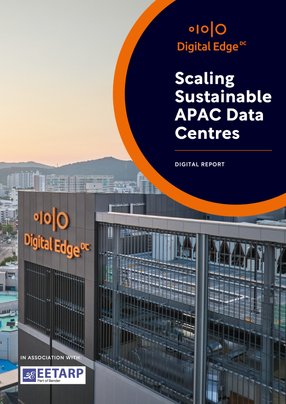
In a region where data demands continue to grow and infrastructure requirements become increasingly complex, Digital Edge has positioned itself as a provider focused on sustainable expansion across the Asia-Pacific (APAC) data centre market.
The company, which now manages 24 data centres in operation or under development, recently secured a US$1.6bn capital injection that signals confidence in its expansion strategy during a period of changing hyperscale demand.
Having been at the helm as CEO since January 2025, John Freeman explains that environmental, social and governance (ESG) principles have guided the company from its inception in late 2019.
“ESG has been embedded as part of our culture and framework from day one when we formed the company,” he says. “It’s really been a core pillar for us and drives every decision that we make across the platform and the entire lifecycle of a data centre whether it’s site selection, operations, power procurement or water usage.”
ESG as the foundation, rather than an afterthought
In his first five months as CEO, John says he has concentrated on institutionalising ESG principles while preparing the company for substantial growth.
Founded in 2020, Digital Edge provides high-quality colocation and interconnect services across APAC – specifically in China, India, Japan, Indonesia, Philippines and South Korea. It has expanded its workforce quickly from a few co-founders to more than 570 employees and seeks to confront both opportunities and challenges while staying true to its operational philosophy of supporting mission-critical business operations.
In order to achieve this, John says the company structures its sustainability approach around three principles: respect for resources, respect for people and communities and respect for Authors transparency.
“Those core pillars drive everything that we do as an organisation especially across the data centre lifecycle,” he explains. “From selecting a site for construction of a new data centre facility, where we want to make sure that data centre has a minimal ecological impact in terms of where we build it to how we design that data centre by making sure that it’s the most efficient in terms of power or water efficiency. These principles are embedded in all of our new data centre projects, including NARRA1 in the Philippines and EDGE2 in Indonesia, which have design PUEs of 1.23 and are already fully powered by 100% renewable energy.”
This comprehensive approach extends to power procurement, with Digital Edge working closely with utility providers to secure renewable energy sources where available, or by looking at what John refers to as “greener power” alternatives where renewable options remain limited.
As this strategy demonstrates, sustainability considerations have become central to Digital Edge’s operational planning, rather than being an offshoot to the side.
John says: “Sustainability is in our culture and embedded in our DNA.”
Operating data centres in tropical climates can often present technical challenges for efficiency metrics. Power Usage Effectiveness (PUE) – a ratio that measures how much energy a data centre uses for computing versus total energy consumption – can become more difficult to optimise in hot or humid environments.
Despite these challenges, Digital Edge is eager to target a PUE of 1.25 or lower across its new greenfield facilities. For context, a PUE of 1.0 would represent perfect efficiency, with all energy used for computing, while the industry average typically ranges between 1.5-1.8.
“We’ve designed our MEP (mechanical, electrical and plumbing) and cooling technologies to achieve these PUE targets,” John notes. “As our customers begin migrating to rack-level liquid cooling, we expect to significantly reduce PUE targets even further, building on the fact that our newly developed sites are already operating at PUE efficient level.”
Water usage inevitably represents another environmental consideration, particularly in regions where potable water supplies face pressure. In India, Digital Edge has implemented a grey water technology solution for its 300MW Navi Mumbai campus – a system that reclaims lightly used water that would otherwise be discharged by the local municipality – to mitigate this and reduce consumption of freshwater resources.
“We work with the local water authorities to find the best ways to leverage the use of their grey water,” John explains. “We work with them to recapture grey water and use it as part of our cooling technology by integrating it into our closed loop cooling towers. By doing so, we lessen the impact on potable water in the surrounding community.”
Navigating APAC and its diverse data centre market
The APAC data centre market is booming and as a result presents unique challenges for data centre operators, given its market diversity. John explains that operating conditions, regulations and infrastructure capabilities can differ widely from one market to another.
“When people refer to Asia, they often think of it as a homogeneous region, but the reality is more nuanced. Operating in Korea isn’t the same as operating in the Philippines or India,” he explains. “That’s why we’ve built a unified platform that ensures a consistent standard of quality, backed by deep local expertise in each market.”
Across APAC, Digital Edge focuses on balancing global standards with local adaptability. While the company maintains central governance over its sites across all aspects of design and build, it delegates the implementation of these frameworks to local teams with expertise in the area.
“Whether it’s through our local teams or local partnerships, or vendors and suppliers, that we work with on the ground in a particular market, we do so because they are the ones with the most understanding of what can and can’t be done,” John says. “It’s about the art of possibility, rather than someone sitting at corporate trying to build and operate a data centre in a particular market.”
Recognising that local teams possess crucial knowledge about a region’s market conditions is what sets Digital Edge apart. By leveraging those critical relationships with local suppliers and vendors, the company aims to navigate local challenges to achieve the best possible operations.
John adds: “We very much value the local partnerships that we’ve developed in each of the countries in which we operate and we seek to leverage that to the fullest extent.”
Digital Edge is also eager to leverage this local expertise to support its hyperscale customers – those large technology companies that require substantial computing resources.
“The hyperscale customers have very specific requirements, which are usually set either regionally or back at the corporate headquarters,” John says. “We work very closely with the hyperscalers to understand their requirements and then work with our local teams who deliver the project to the standards our hyperscale customers require.”
As our customers don’t always know their full deployment roadmap from day one, Digital Edge is able to leverage its strategy of building adaptable infrastructure that can support various deployment scenarios over time, whether air-cooled or liquid cooling in the future.
John adds: “What we're designing and building is a flexible, sustainable architecture that allows our customers to deploy into a facility or campus at scale over time.”
The US$1.6bn advantage
The recent US$1.6bn capital injection that Digital Edge closed in January 2025 provides the company with resources to accelerate its expansion strategy. This funding, provided by infrastructure investment firm Stonepeak, suggests high confidence in the positive direction Digital Edge is going.
“We’re proud to have gained the trust of our investors in securing this capital,” John tells us. “Stonepeak is a great shareholder and partner and this additional capital is a validation of our strategy and our teams’ ability to execute.”
Looking ahead, Digital Edge plans to deploy this capital over the next 12-18 months, with two primary focus areas. First, the company intends to expand its presence in existing markets to support the growing demands from its customers. Second, it aims to enter several new markets to complete its regional footprint and support its customers expansion plans.
“We started this platform as an APAC platform provider, supporting our customers and the digital economy in these markets. As we grow, we will continue to focus on Asia, adding some new markets to complete our digital footprint in the region,” John says.
“This capital also gives us more flexibility in terms of deploying new technologies. We’ll continue to look at the latest technologies from a sustainability standpoint and leverage these technologies in order minimise our impact on the environment in which we operate.”
In order to achieve sustainable growth, Digital Edge has partnered with Eetarp, a provider of building management systems and energy monitoring solutions.
The partnership is part of Digital Edge’s pledge to extend its environmental strategy to its supply chain relationship. It has led to the implementation of integrated building management systems in Jakarta, Indonesia and power metering solutions in a new 36-megawatt data centre in Seoul, South Korea.
“Our partnership with Eetarp exemplifies how we collaborate with our supply chain to achieve our sustainability metrics and our gold standard operational standards across the platform,” John says. “We integrate their technologies into our platform and we will continue to look to partner with them, particularly as we continue to scale across the APAC region.”
How Digital Edge hopes to confront future data demand
The APAC data centre market is quickly closing the gap, driven by AI and machine learning adoption, with global technology firms continuing to invest and build new facilities across the region. What’s clear is that the potential for growth is only continuing to rise.
“In APAC, I think we’re in the early innings,” John says. “The US is more advanced when it comes to AI deployments, but – given the scarcity of supply in the US – a lot of hyperscalers and AI companies are starting to look to deploy in Asia. So we envision exponential growth in the next few years.”
John references some of the major players as examples, who pulled back from new data centre investments earlier in the year.
“We’re mindful of that and believe this is a short-term market adjustment,” he explains. “To address this uncertainty, I think any service provider, including Digital Edge, needs to be flexible on how they design their data centres when building on spec. We need to design our buildings to cater to 80% and adjust the remaining 20% to satisfy a particular customer's requirements near real time.
“We need to make sure that our facilities and infrastructure are able to flex depending on who requires that capacity today as well as tomorrow.”
With its funding secured and clear sustainability frameworks, Digital Edge intends to expand its business significantly within the next two years.
“We have 24 data centres, either in operations or currently under development,” John says. “We’re going to substantially scale our platform over the next 24 months – with a view to keep supporting our customers as they grow their business across APAC.”
To read the full article in the magazine, click HERE.