
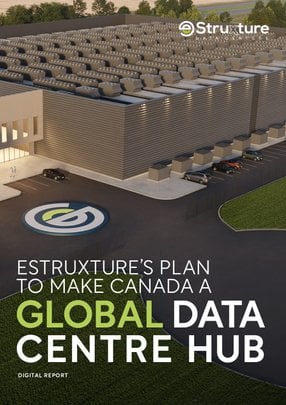
eStruxture’s Plan to Make Canada a Global Data Centre Hub
Canada is emerging as a powerhouse in the global data centre industry. At the forefront of this transformation is eStruxture, the largest Canadian data centre provider, which is executing an ambitious strategy to position Canada as a premier destination for digital infrastructure.
Todd Coleman launched eStruxture in February 2017. As Founder, Chairman, President and CEO, he leads a company that now operates 16 facilities across four major Canadian markets. Today, the business serves more than 750 corporate customers, ranging from small enterprises to the world's largest hyperscalers.
"We founded the company because we forecast that power densities were going to increase over the years, and more importantly, data was going to localise in Canada," Todd explains.
Todd describes himself as "a recovering lawyer" who made the transition to entrepreneurship, where he has since made a name for himself in the tech sector.
"The benefit of being a lawyer is it teaches you how to think," he says. "It teaches you to ask a lot of questions and encourages you to be comfortable not knowing what you don't know." That questioning mindset served him well as he moved from law to technology.
Todd's path into data centres began on the fibre optic side of telecommunications. He learned how data centres function at the network level, particularly their role in traffic exchange. This led to him co-found Cologix, a data centre provider, before founding eStruxture. His experience living through the dot-com bubble proved instructive. "Telecoms were haemorrhaging billions of dollars a year," he recalls. "You learn a lot about what not to do."
That experience shaped eStruxture's focused approach. "We do five things and we do them really, really well," Todd explains. "We don't chase bright, shiny objects, get them to 60% completion and then get distracted."
Taylor Hammond, Chief Commercial Officer at eStruxture, joined the company in August 2024 and has been a key part of the company’s success in the past 18 months. His responsibilities span everything from corporate strategy and site selection to power procurement and capital structure. Like Todd, Taylor arrived in the industry through an unconventional route. He trained as a mechanical engineer before finding his way into investment banking, where he often worked with telcos.
"I met the eStruxture team in 2019, had a chance to work together on a number of transactions," he explains. The relationship evolved over time, and Taylor moved from being the team’s banking advisor to become one of its core leaders.
The company describes itself as a carrier and cloud-neutral data centre operator, designing, building and operating critical infrastructure for its customers. "We’re built on a foundation to serve financial, media, telco, enterprise and government customers," says Taylor. Over the years, our business has expanded into hyperscale markets and we have established preferred-provider relationships with some of the world’s largest cloud computing companies.
As the largest Canadian data centre company, eStruxture’s national identity is an important part of its story and its business model. “We are 100% Canadian,” says Taylor. “This grounds us – and makes us eager to serve the market we live in. It really comes down to relationships and partnerships.”
Todd emphasises that this relational approach extends beyond contracts. "For us, a relationship begins with a handshake, and extends into a belief system around how we treat our partners and how we expect to be treated in return," he explains. These partnerships span manufacturers like Vertiv, which produces data centre infrastructure equipment, service providers, banking relationships and government entities at federal, provincial and municipal levels.
The company's customer relationships reflect this philosophy. "Many of our customers see us as their strategic development partner across Canada," Todd says. This includes both local and global customers. The trust factor is critical in an industry where infrastructure investments run into billions.
Canada's competitive advantages
Canada's appeal as a data centre destination has been growing for years now. "We're a strong trading partner to the world," Taylor explains. "Relative to a lot of other places, Canada has a relatively stable political climate and economy."
Technical fundamentals strengthen the proposition. "We've got a cool climate which supports efficient data centres," Taylor explains. Lower temperatures reduce cooling costs, which is a significant operational expense for facilities generating substantial heat from computing equipment. Canada benefits from eight or more months of “free” cooling, where data centres can pull in outside air in a low power usage effectiveness environment.
The country has deep talent pools on multiple fronts. Skilled trades workers support facility construction. Technology experts handle operations and design of sophisticated systems. "We've got an amazing national fibre backbone and available land," Taylor adds.
Power infrastructure represents perhaps the most critical component. "We've got some of the world's foremost power experts in Canada, a number of whom we have partnered with to build power infrastructure across our country," Taylor says. Canada's abundant power resources historically provided a robust foundation, though artificial intelligence demands are changing the landscape.
Todd says there are other factors driving data localisation to Canada. For example, data protection laws, many originating in the EU, require that certain information types remain within sovereign boundaries. "Personal, financial, medical data have to be localised within the sovereignty," he explains. This regulatory framework positions Canada advantageously.
Economic factors also play a role. Currency strength has made Canada attractive for companies moving data demands north of the US border. Lower costs of living and operating provide further incentives. "You factor in things that were unpredictable along the way, including trade wars and geopolitical environments," Todd notes. "All those things make Canada a super healthy place to store your data."
The proximity to key US markets adds strategic value. Canada sits close to major content creation and consumption centres while offering regulatory and economic advantages. This combination attracts global players seeking North American presence with enhanced data sovereignty protections.
Building at scale
Since Taylor joined eStruxture, the firm’s strategy has been hyper-focused. "The number one focus has been scale," he states. This represents continuation and intensification of the company's founding vision. Scale permeates everything from people and processes to tools supporting ongoing buildout across the country.
Crucially, eStruxture invested ahead of market curves and is now set to reap the rewards. "We were the first hyperscale provider in the Alberta market," Taylor explains. Alberta has grown into a tremendous data centre market where eStruxture maintains leadership. The company is currently building the province's largest site at 90 megawatts, scheduled for autumn 2026.
The evolution reflects broader industry trends. When eStruxture first started, high density meant five to eight kilowatts per rack for most providers. In contrast, eStruxture was one of the few firms offering far higher capacities.
"We started off the business doing 30 kilowatts a rack with air cooling out of the box," Todd explains. The company positioned itself as the high-density specialist from inception. That positioning proved prescient. "Now we've gone from 30 kilowatt racks to 50 and 150 kilowatt racks," Todd says. The company approaches 600 kilowatts to a megawatt per rack. This progression required specialisation in high-density cooling, largely air-based but increasingly incorporating liquid cooling to the chip.
Todd describes his company’s current phase as "eStruxture 2.0", which is an evolution built on foundational principles. The strategy centres on owned real estate underpinning sites and high-density, large-scale facilities. CAL-3, the 90-megawatt facility under construction, exemplifies this approach as a prime example of the company's development philosophy.
Capital structure evolved to support this scale. A US$1.4bn debt financing in 2024 followed a US$1.8bn equity financing with infrastructure investors the previous year. "This has really supported that buildout and continues to support that build-out," Taylor notes.
Team investment matched financial commitments. eStruxture grew to more than 150 employees across executive and operating levels. "We're well over 150 employees strong and growing," Taylor says. This workforce executes on ambitious development plans.
Crucially, the company has ring-fenced more than 500 megawatts of power and hundreds of acres of land across Canada supporting its development pipeline. This land banking strategy has helped to position eStruxture for a sustained period of expansion.
Government partnerships and data sovereignty
The Canadian government's Buy Canada initiative is a significant development in the data centre landscape. The policy emerged partly in response to trade tensions and geopolitical uncertainties. "A lot of this was driven by trade wars and tariffs," Todd explains.
The initiative focuses on developing Canadian businesses and entrepreneurship while addressing data sovereignty concerns. There are certain types of data – personal, financial, medical – but from a Canadian government perspective, there is also data associated to the country’s most valuable assets, Todd notes. These require frameworks that ensure Canadian sovereignty and control.
eStruxture's 100% Canadian ownership positions the company advantageously. "We're Canadian headquartered, owned and controlled," Taylor states. "We're investing across the country." The company developed long-term relationships with federal and provincial governments, positioning itself as a trusted advisor.
The government's recognition of digital infrastructure's importance manifests in concrete ways. "This is the first federal government that has appointed a Minister of AI and Digital Innovation," Taylor explains. "We are super proud of that." The appointment shows just how highly the government currently values the AI and digital infrastructure economies.
Todd is clear that Buy Canada is not about the exclusion of the rest of the world. "Despite the push for Buy Canada, the doors are open at a global level, and partnerships are being brought in and developed every single day," he says. Canada remains fundamentally business-friendly at federal, provincial and municipal levels.
The government's approach balances domestic development with global engagement. "They've recognised that they're building and investing around the data economy," Todd explains. "The Buy Canada policy really is focused on investing in Canadian companies, developing Canadian entrepreneurship, but more importantly, it goes back to data sovereignty."
eStruxture participates in discussions around sovereign data centres as part of Canada's sovereign AI framework evolution. "We're working with the government in discussions around what sovereign data centres look like," Todd reveals. These conversations shape how Canada positions itself in the global AI economy.
The company serves as what Todd describes as "arguably the flagship data centre operator in Canada" which gives eStruxture influence in shaping policy discussions. “We want to make sure that we’re building our economy in the future with Canadian products and Canadian companies, and in order to make sure that that happens, the government will have to play an incentivizing role in some places,” AI and Digital Innovation Minister Solomon said.
Serving diverse customers
eStruxture faces a unique challenge when balancing the needs of vastly different customer types. Global hyperscalers, the largest technology companies operating massive cloud computing platforms, operate on forward-looking buying cycles with substantial balance sheets. Enterprise customers typically have leaner internal resources and shorter planning horizons. The company invests differently to satisfy both segments.
"We make specific investment decisions targeted towards both Canadian entities, but more importantly, that are enterprise focusedfocus," Todd explains. Market dynamics shifted from buyer's to seller's conditions over recent years. Supply constraints mean declared capacity often sells through before reaching full commissioning.
"If it's on a 12 to 24 month build cycle, there's a high probability that itsit's capacity is 100% sold through before we even get it fully commissioned and operational," Todd says. This presents challenges that require strategic allocation between customer types with different specifications and timescales.
The company's basis of design evolves to meet varying requirements. "We got building blocks that we put in for our large-scale data centres, but certain attributes are more critical to enterprise than they would be to hyperscaler," Todd explains. This flexibility allows eStruxture to serve the full customer spectrum.
The approach shows that eStruxture can both walk the walk and talk the talk. "We've proven ourselves as real operators over many years, and frankly, we've proven that we put real money into the ground,” Todd says.
The company's track record demonstrates this commitment. Facilities announced 12, 18 or 24 months prior become operational assets, typically at capacity. This execution distinguishes eStruxture from competitors pursuing speculative strategies.
What does the future hold for eStruxture?
Looking to the future, eStruxture's rapid growth shows no signs of slowing down. "We've been on a rocket ship growth trajectory for the last eight years," says Todd. "It's not changing, if anything, we're turbocharging the rocket." The company is deploying massive capital at breakneck speed across Canada.
Development plans extend through 2030 with phased approaches bringing hundreds of megawatts online. "The next 12 to 18 months are the building blocks to bring brand new facilities, significant amounts of power, online and available," Todd explains.
Taylor reiterates just how strong eStruxture is becoming. "We believe the best is yet to come,” he says. "We've put in place all of the pieces to continue to build out as the leading Canadian data centre provider." The company expects large-scale investments across Canada to continue.
With AI booming and the demand for data centre capacity soaring, eStruxture’s position as Canada’s premier provider is one of great responsibility. For Todd, the company is "the AI enabler in the Canadian market".
With continued investments in all major Canadian markets lined up, eStruxture's national footprint is always on widening.
The combination of owned real estate, secured power, assembled talent and established partnerships provides the foundation for sustained growth. These elements represent the building blocks Taylor references when discussing the company's preparation for the next phase.
"Our goal is really to establish a leading position on the global stage as a country that leads digital infrastructure at the forefront," Taylor concludes.
Company portals

Executives

Taylor Hammond
SVP, Chief Commercial Officer

Todd Coleman
Founder, President and CEO, eStruxture