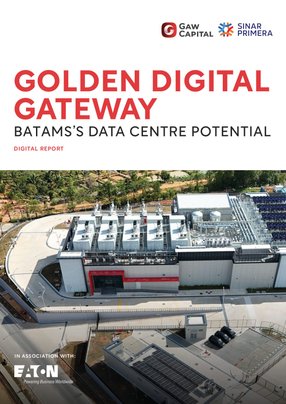
Golden Digital Gateway: Indonesia’s Data Centre Potential
The Southeast Asian data centre market faces a capacity problem. Singapore, the region’s dominant hub, closed its doors to new developments in 2021 due to power constraints, forcing hyperscalers and enterprises to find alternatives quickly.
This challenge has created opportunities for operators willing to invest in less proven locations. Asia-based Gaw Capital Partners and Jakarta’s Sinar Primera have placed their bet on Batam, a small Indonesian island 30 minutes by ferry from Singapore, where they launched the Golden Digital Gateway facility in February 2025 as the first operational data centre in the Nongsa Digital Park.
Singapore’s data centre market generates US$1.4bn in annual revenue from a population of just five million, demonstrating the revenue density that makes proximity to the city-state valuable. The moratorium, implemented to address electricity grid constraints, has redirected investment flows across Southeast Asia as customers seek alternative locations that can deliver similar connectivity and latency performance.
“It’s a fantastic joint venture that brings together two partners and allows the various parties to complement each other in terms of skills,” says Nicholas Toh, Managing Director – Head of Data Centre Platform, Asia at Gaw Capital Partners. “Gaw Capital has a deep history and experience in designing, building, owning and operating data centres.
“Within Gaw Capital’s data centre portfolio, we have assets in Kuala Lumpur, Malaysia, Tokyo, Japan, Seoul, Korea and Ho Chi Minh, Vietnam with investments in Chinese operators Centrin and Jinke that serve Chinese hyperscalers.”
Sinar Primera, meanwhile, provides local market knowledge essential for navigating Indonesia’s business environment.
Kah Jin Hong, Head of Sinar Primera Group, explains how his firm’s entry into data centres was a strategic response to accelerating market conditions. “About three to four years ago, the market was really heating up in Indonesia, and we were looking for partners to reach out to, as it’s not an easy space to enter,” he says. “We came across Gaw Capital and it was a good partnership. We’re able to bring different things to the platform.”
Singapore moratorium creates Batam opportunity
Singapore’s position as a regional hub stems from decades of infrastructure investment. The city-state hosts 27 submarine cables connecting to international networks: the largest submarine cable hub in the Asia-Pacific region. Power consumption from data centres reached levels that prompted government concern about grid stability, leading to the 2021 moratorium while authorities evaluated infrastructure capacity.
This forced customers who previously would have deployed exclusively in Singapore to evaluate alternatives. Malaysia’s Cyberjaya and Johor regions have attracted significant investment, along with Thailand, the Philippines and Vietnam.
Batam offers advantages that distinguish it from other alternatives, though. The island sits approximately 20 kilometres south of Singapore with established ferry connections. More importantly, its Special Economic Zone designation provides tax advantages including zero import duties, value-added tax exemptions and reduced corporate tax rates.
“Our view is that it’s not a question of if Batam will blossom, it’s a question of when,” Nicholas says. “As a data centre customer today, it’s very difficult to get capacity in Singapore, which is why customers will start to look at options beyond.”
Batam’s submarine cable infrastructure includes 12 cables with direct links to Singapore, enabling sub-2 millisecond latency connections. “We think Batam is very strategic, given it’s got 12 submarine cables of its own, directly connecting with Singapore, and can offer less than 2ms of latency,” says Nicholas. “Customers could potentially come here to Batam and then leverage that location and the strategic position of Singapore as one of the key data centre hubs in APAC.”
Golden Digital Gateway construction addresses logistics challenges
Data centre construction in established markets benefits from mature contractor ecosystems and established supply chains. Batam, therefore, presented logistical challenges that required adapting construction approaches to an island environment with limited local expertise.
Indonesia’s data centre construction capabilities are concentrated in Jakarta, leaving Batam without established contractors familiar with modern facility requirements. Kah Jin describes this as the project’s most significant challenge.
“One of the challenges for us in Batam was that while it’s near Singapore, a lot of the construction expertise is in Jakarta,” he says. “One of the main issues was to find the right construction partners to work with that would be able to execute [the project] on the island.”
The solution required convincing Jakarta-based contractors to establish temporary operations in Batam. The nine-month timeline from groundbreaking to operational status required careful coordination while maintaining construction schedules that would enable first-mover advantages.
“We managed to deliver the facility within nine months from the point we went in, which was in May, and we commenced operations in February,” says Kah Jin. “That was pretty fast, and that’s why we were able to complete this and open up as the first data centre to open in Batam at that point in time.”
The first-to-market advantage provided early access to power allocations and established relationships with local infrastructure providers. Multiple operators have since announced developments in Nongsa Digital Park, validating the location while increasing competition.
Site conditions added complexity to the project. The park required extensive land preparation and infrastructure development. Nicholas describes the transformation: “When that project first started, as I understood, it was literally just forest land. All of that has now been cleared for a number of other data centre operators that are all within the Nongsa Digital Park.”
Eaton partnership delivers integrated power solutions
Data centre power systems represent one of the most critical infrastructure components, where failures can cause customer service breaches and potential data loss. Traditional construction involves assembling power components from multiple manufacturers on-site, creating risk where incompatibilities can cause commissioning delays.
The partnership with Eaton addressed this through factory-integrated power train units that combine uninterruptible power supplies (UPSs), switching gear and distribution equipment in pre-tested configurations.
“Everyone knows Eaton is a household name in this business. We worked with them on the power train units here,” says Kah Jin. “The beauty is that they were able to provide us with an end-to-end solution. With new data centres, a lot of testing is done on-site. But now, we work with Eaton on these power train units, where the UPS and all the different components are connected.”
Factory testing eliminates uncertainty about system functionality during commissioning. “This ensures that everything works coming out of the factory, which reduces a lot of our construction risk. If things don’t work and can’t be commissioned on-site, there’ll be a major issue with our timeline,” says Kah Jin.
Beyond power systems, the facility's connectivity strategy required partnerships with multiple fibre providers. Kah Jin describes these as essential: “We work with different fibre connectivity providers into our site. We have an understanding with SPTel, which is a local provider that provides fibre connectivity from Batam right to Singapore via the government gas pipeline link between Indonesia and Singapore. We also work with different partners as well, like SEAX and Moratel.”
Sustainability features target certification standards
Environmental considerations have evolved beyond energy efficiency to encompass water consumption, construction waste and carbon footprint. Golden Digital Gateway targets Building and Construction Authority Green Mark certification from Singapore’s green building programme.
“At Gaw Capital, whenever we’ve designed our data centres, sustainability is extremely important, and we try to embed it into every phase of the DC design, construction and operations,” Nicholas outlines. “Specifically at Golden Digital Gateway, during construction, we used recycled materials and repurposed some of the excavation waste into the landscaping.”
Taking a modular approach to data centre construction has helped reduce on-site waste through factory-controlled manufacturing. “We made sure that we constructed the building on a very modular basis,” Kah Jin describes. “A lot of the things we built were tested in the factory before we shipped them out. For our project, we were able to achieve BCA Green Mark certification.”
The facility’s cooling design prioritises air cooling over water-intensive systems. “What’s unique about our facility in its first phase is that we are air-cooled, so we have less reliance on water, which is becoming more of a scarce resource,” says Kah Jin.
What’s more, the infrastructure incorporates flexibility for future requirements as AI workloads may require liquid cooling systems. “We’ve tried to ensure the design we’ve come up with is as future-proof as possible,” says Nicholas. “We’ve got quite a lot of flexibility in tweaking the design in the future to effectively account for changes that are potentially coming in terms of high-density racks and the liquid cooling that is potentially required for AI workloads.”
How AI is driving infrastructure evolution
The rapid adoption of AI applications has transformed data centre infrastructure requirements. GPUs designed for AI training consume substantially more power than conventional server processors – generating heat that requires enhanced cooling systems.
Hardware evolution cycles have accelerated from traditional three-to-five-year refresh patterns to annual upgrades. Kah Jin describes the challenge: “That’s always a challenge with this business. Every year, Nvidia’s Jensen Huang is up there on stage, one-upping himself and coming up with a new chip, and every chip increases the number of kilowatts it needs. Data centre rack density has increased almost tenfold in a matter of two or three years.
“That’s why building something quick and on time is key. Getting up the core and shell is really important because the mechanical and electrical elements just constantly change,” says Kah Jin.
AI infrastructure requirements are reshaping site selection criteria globally. Nicholas describes how power requirements are influencing location decisions: "With what’s happening with AI, especially across Europe and the US at the moment, data centres are actually being built next to where the power is because power is such an important consideration. It’s rewriting the rule books."
Nicholas expects older facilities to serve applications that don't require the latest hardware rather than becoming obsolete. “The analogy I have is akin to iPhones. I’ve got an iPhone 15; my daughter has an iPhone 10 from five years ago. That doesn’t mean the iPhone 10 can’t do the same things,” he says. “The analogy I would take to data centres is that as long as they are properly maintained, there will be different use cases for the older data centres in the future.”
Batam Phase 2 expansion targets Jakarta industrial park development
The partnership’s immediate focus centres on the 20MW Phase 2 development on adjacent land within Nongsa Digital Park. This expansion will more than double the facility’s capacity while establishing the joint venture as a major operator in Indonesia’s emerging data centre market.
“Our immediate priority is to develop Phase 2, which is the adjacent parcel of land,” says Nicholas. “That’s 20 megawatts in addition to what we have there already.”
Beyond Batam, longer-term expansion plans target Jakarta, where Indonesia’s data centre market is most developed and where Sinar Primera maintains strategic land holdings. The capital offers established power infrastructure, water availability and proximity to the country’s largest enterprise market.
“We’ve got more sites available in Jakarta. That’s the other hub where most of Indonesia’s data centre build-out is,” says Kah Jin. “We definitely hope to expand and leverage that. Jakarta has a lot of power, we've got land and we've got water, so that’s a potent combination.”
The Jakarta strategy extends beyond individual facility development to creating purpose-built data centre industrial parks that could provide economies of scale and attract multiple operators to shared locations.
“We are developers doing our own industrial park, and we hope to build a data centre industrial park that will cater more to data centres, akin to what you see elsewhere,” says Kah Jin. “We hope to replicate that model in Jakarta and definitely hope to grow with Gaw Capital to build more and meet more of our customers’ needs.”
The partnership model that enabled success in Batam could be replicated across Indonesia's fragmented market, where local expertise remains essential for navigating regulatory requirements and establishing operational relationships.
“From our perspective at Gaw Capital, we’re very excited about the partnership, and we think that there’s a lot that we can do together in Indonesia,” says Nicholas.