
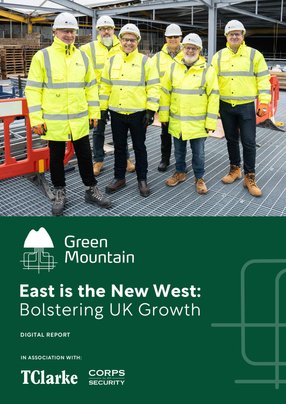
Green Mountain: East is the New West - Bolstering UK Growth
The UK data centre market is currently facing unprecedented pressures on its infrastructure. Power constraints in traditional data centre locations, combined with increasing demand for land, are inevitably creating challenges for operators seeking to expand their footprint amid growing demand.
These pressures are only intensified by the demands of AI and high-performance computing (HPC), which can require anywhere between 25 to 120 kilowatts (kW), or more, of power per rack compared to 5-10kW for traditional compute.
Such a dynamic market is driving strategic shifts in where data centre operators choose to locate their facilities. Within this context, Green Mountain, a data centre operator providing colocation services, is expanding its London footprint with a 30-megawatt (MW) campus development in Romford, East London.
The company is aiming to deliver its first 14MW phase in 2025, targeting AI/HPC capabilities, whilst also maintaining its focus on sustainability through renewable energy use and efficient design.
Seizing the opportunity of the London data centre market
Historically in the UK, The City of London and West London have been the primary location for UK data centres because of, for the former, its proximity to the financial markets, and for the latter, the already-established power infrastructure and deployment of fibre. However, power constraints and capacity limits have forced operators to consider alternative locations. Several operators have migrated to East London where power availability and land resources remain accessible.
“With financial institutions demanding and consuming ever growing amounts of connectivity, the fibre infrastructure in and around the City of London and Docklands began to mature in the latter part of the twentieth century,” explains Simon Blackburn, Managing Director of Green Mountain UK. “The early ‘carrier hotels’ played a crucial role in this growth, creating a connectivity eco-system. Data centres were being built close to where they could be easily and well connected.
“Fast forward another 10 to 15 years, a similar transformation took place in Slough, where new data centre hubs grew. Today, London remains one of the key business centres in the world with an insatiable demand for data. As a result, the growth in the city’s data centre market is set to continue to increase.”
He adds: “That said, West London has become massively congested. Power is now at a premium, almost to the point where it's run out and land prices are rocketing.”
As the largest data centre market in the FLAP-D group (Frankfurt, London, Amsterdam, Paris and Dublin), London's position in global markets continues to drive data centre demand. In particular, the location of East London offers greater power availability, land resources and an already well-established connectivity infrastructure.
This area of London also provides lower rental costs compared to West London locations, combined with greater transport infrastructure. As a result, data centre operators, including hyperscale, are moving east as they continue to provide cloud, networking and internet facilities at scale.
Green Mountain grows East London presence
Green Mountain is one such company committed to its East London strategy, expanding its campus development in Romford, referred to as LON-East.
Simon explains how the LON-East build is based on strategic growth: “We're expanding our Romford campus by 30MW over two buildings. The first 14MW is currently under construction and will be ready in the second half of 2025. We've chosen to build the full 14MW speculatively to have capacity available quickly, in a market where demand exceeds supply and most new capacity coming online is already pre-let.”
The first 14 MW of capacity is an expansion of the existing data centre which has been operational since 2010. The building was originally an old tobacco warehouse, which had been converted to a large distribution centre.
The remaining 16 MW of capacity will be a new building, taking the total campus capacity to just under 40 MW.
“Programme Delivery Director Gary Hutchings explains: “The build will be HPC and AI-enabled and is designed to the highest standards of sustainability and energy efficiency, with a PUE of c. 1.2.”
A Power Usage Effectiveness (PUE) target of 1.2 represents significant energy efficiency compared to the industry average of c. 1.57.
Construction in a live data centre environment
It goes without saying that maintaining the availability of the existing services during the expansion is of paramount importance. T. Clarke was selected as Green Mountain’s General Contractor to undertake the construction given their experience of building around live data centres. A decision that has already paid dividends.
From delivering the largest indoor installation in Europe, of over 330 helical piles (12 metres deep) to support the new mezzanine floor, to erecting over 850 tonnes of steel all around live services, the T.Clarke partnership is a success. Its approach prioritises maintaining live services during construction, rather than adapting services to fit the build. This shift in mindset has been significant and highly effective.
Green Mountain is also committed to operating its sites safely. “It was key to ensure our construction partner demonstrated the same culture which I am pleased to say is the case,” says Simon. “Not only do they care about the quality of their work, but they also care about how they do it. As members of the Considerate Constructors Scheme, T. Clarke has actively engaged with our neighbours during the construction to keep them updated and addressed feedback to minimise any disruption experienced.”
With the enablement works complete and moving into the M&E fit out stage, the project remains on track, and within budget.
Green Mountain’s pedigree in delivery is clear and is underpinned further by their recent 90 MW build in 18 months in Norway for TikTok.
Prepared for AI and HPC workloads
With the exponential growth and the seemingly unfettered investment in AI, demand for data centres will continue to increase. Some reports suggest a CAGR of 18% to 2030, making it critical that new data centre capacity is capable of dealing with the HPC workloads that are required.
Whereas some data centre operators are having to retrofit their existing infrastructure to become “AI ready”, LON-East’s technical specifications are designed to accommodate modern computing demands.
“Our current base design can accommodate workloads up to 45kW per rack when using air cooling technology and in excess of 100kW per rack if we use liquid-to-liquid cooling or a hybrid liquid cooling solution,” Simon adds. “Green Mountain has already developed and deployed these solutions in Norway for automotive and IT solutions customers.”
Reducing carbon emissions
Whilst construction is going well, Green Mountain is eager to continue supporting its sustainability pledge. The operator’s environmental strategy includes procuring 100% renewable energy and the use of hydro-treated vegetable oil fuel (HVO) for its backup generators, a strategy that is becoming more popular within the data centre industry to adhere to emissions targets.
In fact, Green Mountain has found that HVO can reduce carbon emissions by up to 90% compared to traditional diesel fuel. This echoes the company’s pledge in its 2023 Sustainability Report to use HVO fuel instead of diesel for back-up power in its new expansion projects in the UK.
“While we don't have the same environment and climate conditions as Norway, we do have the same ethos,” Simon explains. “We're also looking at alternative renewable power options. We are keen to innovate and work with our existing customers to maximise efficiency in the data halls and push down the PUE further on site.”.
Delivering operational excellence
Green Mountain also prides itself on its operational delivery with a transparent approach and 100% uptime record. It has a number of ISO certifications covering Quality, Service Management, Health, Safety and Environment and Information Security. During 2025, the aim is to add Energy Management to that list of certifications.
Lee Robinson is Technical Operations Director of Green Mountain UK. “My role is to oversee the existing infrastructure and make sure we're delivering operational excellence to our existing customers,” he says. “My part in the upcoming project is to ensure that none of our services are impacted. We've maintained 100% availability ever since we first built this building more than 14 years ago and our intention is to maintain that with future customers.
The Green Mountain team has plenty of experience to underwrite this pledge, with the average length of employee service being nine years. There is also a strong relationship with CBRE who deliver the facility maintenance, stretching back 12 years.
Green Mountain’s UK expansion also enables the operator to provide more opportunities to enhance the security of its site. Barry Long, the company’s Head of Security, works very closely with Green Mountain partners to oversee CCTV across its sites, including LON-East, and its access control systems.
He explains: “The expansion gives me the opportunity to work more on the design element. This location was built a number of years ago, so it is now all about looking at the latest technology and how we can incorporate that with the new build, as well as the current build, so we can transition even further towards new technologies that can create impact."
Keeping the customer at the heart of everything
Green Mountain continues to serve clients across multiple business sectors, whilst maintaining long-term relationships through its commitment to operational excellence.
“At Green Mountain in the UK, we have a wide array of different customer types from different demographics and different backgrounds. Some of our customers have been here for well over 12 years,” Graham Harvey, Service and Account Director of the company explains. “We regularly reach out to our customers to gain feedback and, since we first went live in 2009 with our first customer, we have retained 94% of all business.
“Our primary focus is on our customers, ranging across the design, build and operational stages.”
The future
Looking forward, The East London data centre market will continue to develop new capacity, particularly as the wider industry keeps responding to infrastructure constraints in traditional locations. This location will be needed to support a range of disruptive technologies, including AI, HPC and other critical tools required to maintain a future-proof business model.
“There is a genuine view that with that move from West to East, there will be a new availability zone in East London,” Simon explains. “Hyperscalers are moving east, other colocation providers in east London are expanding. New builds are being proposed in both the Docklands and East London moving further into Essex.”
Such a shift represents a broader market evolution, as Simon notes: “East London has power and land available, and is built around connectivity. “It has lower rental costs than West London and hugely convenient transport links. We can see that the market is starting to move East with the West being saturated. and Green Mountain is ideally placed to support this.”
With strong backing from the owners, Green Mountain has an ambitious growth plan in the European market.
“Green Mountain’s data centre in the UK is a key strategic focus and essential for our continued growth.” adds Svein Atle Hagaseth, CEO of Green Mountain.
Simon concludes: “The demand for data will only continue to grow. Processors may get smaller and more powerful, but there will always be a need to store and operate them in data centres that are able to provide power and cooling in a secure and sustainable way.”
Explore the latest edition of Data Centre Magazine and be part of the conversation at our global conference series, Tech & AI LIVE and Data Centre LIVE.
Discover all our upcoming events and secure your tickets today.
Data Centre Magazine is a BizClik brand
Company portals
Executives

Simon Blackburn
Managing Director of Green Mountain UK