In Swahili, kasi means speed. In Zulu, it means velocity. In some Kenyan dialects, it means work. To Johnson Agogbua, Co-Founder and CEO of Kasi Cloud, kasi captures everything meaningful to him, his company and its work.
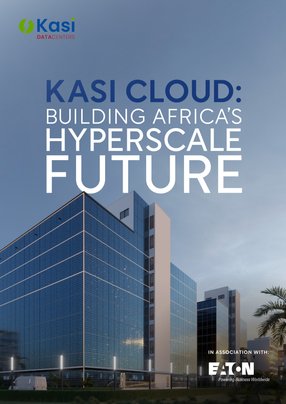
Kasi Cloud is a Lagos-based hyperscale data centre company building the digital infrastructure that Africa’s economy needs to compete in the age of AI. It sits on 4.2 hectares of land in the heart of Nigeria's commercial capital, a major African economic hub. Its flagship facility – designed from scratch to accommodate the power densities and rack configurations demanded by major cloud providers and AI workloads – is now preparing to onboard its first customers.
More than 600 million people across Africa remain underconnected and 700 million are unbanked – cut off from the financial services that increasingly depend on reliable digital infrastructure. Cloud computing, which allows businesses to access computing power and storage remotely via the internet rather than owning physical servers, had barely entered Africa when Kasi Cloud was founded just a few years ago. AI had barely entered the conversation.
“Digital infrastructure in Africa is an urgent problem of now,” Johnson declares. “Africa cannot afford to fall further behind.”
The founding of Kasi Cloud
Johnson has spent more than three decades building the infrastructure that underpins the connected world, having helped build the early internet infrastructure at UUNET Technologies – one of the first commercial internet service providers in the United States. He then moved to Movaz (now ADVA), a specialist in optical networking which uses light pulses transmitted through fibre-optic cables to carry vast quantities of data across long distances. He then joined Meta, where he worked on connecting the next billion users.
Then came India. Johnson led the team that helped design what became Reliance Jio, the telecoms network that transformed connectivity for more than a billion people across 22 licensed telecom circles — each representing a distinct geographic region with its own regulatory requirements. He asks: “Which other population approximates India – not density but sheer population? Africa.”
That question became the founding logic of Kasi Cloud, which Johnson launched with Co-Founder Mark Adams, a former Chief Strategy Officer at Equinix. The pitch was made formally at the Pacific Telecommunications Council conference in early 2020, right before the COVID-19 pandemic.
Rather than wait out the pandemic in Silicon Valley, Johnson flew to Nigeria. The enforced stillness of lockdown turned out to be an unexpected advantage. He spent months conducting site visits, meeting enterprises and assessing exactly what the market required. The company then acquired 4.2 hectares which sent a deliberate signal of intent at a moment when most data centre operators in Nigeria were working from single plots or repurposed containers.
DH Capital, a specialist infrastructure investment firm now acquired by Citizens Bank, provided seed funding, then the Nigerian Sovereign Wealth Fund came in. By 2021, Kasi was scaling its promise and just another year later, in 2022, foundations were in the ground.
“The best companies are forged at the toughest time,” Johnson says. “That's how Kasi started.” And on top of the sentiments of its truly African name, Kasi is carried by its motto and tagline – unstoppable capacity – that follows naturally.
Built with hyperscale with intention
What sets Kasi apart from existing data centre operators in Africa is not simply scale, but the design philosophy that underlies it. Johnson is firm in laying out that Kasi was not established to retrofit an existing facility or adapt a standard enterprise data centre model for the African market. Kasi facilities are designed from scratch, asking what Africa’s digital economy would need not today but a decade from now.
Johnson drew directly on his experience at Meta, where rack units – the standardised metal frames that hold servers – run from 52U to 58U in height, reaching 2.7 metres, packed with graphics processing units (GPUs), the specialised chips that power AI workloads, alongside storage and compute systems.
“The power density is a different thing entirely,” Johnson explains. “You need a different design.”
That design process was collaborative from the start. Johnson held sessions with hyperscalers – large cloud providers such as AWS, Microsoft Azure and Google Cloud – as well as with enterprise customers, asking granular questions about conduit capacity, storage facility dimensions and how their compute requirements might evolve over the next decade. The result is a facility designed not to become obsolete as AI workloads intensify.
A key feature of Kasi’s infrastructure is the meet-me room – in this case, offering a telling illustration of the company’s ambition. Kasi has built two redundant meet-me rooms, each the size of an entire existing data centre in Lagos, according to a senior network executive who recently toured the facility.
“Things that people don't think about, we obsess over them,” Johnson continues. “When they grow, customers can have confidence that we’ve got their back.”
Solving Africa’s power problem
Power is one of the greatest infrastructure challenges in Nigeria – and by extension for any data centre operator working there. With an unreliable national grid, most commercial operations depend on a combination of grid supply and diesel generation. For a data centre, where uptime is of paramount importance, this is far from a secondary concern.
To overcome this issue and to build a future-proof data centre, Kasi undertook a wholesale redesign of data centre power architecture for the African context. That meant rethinking every step of the power delivery chain: from utility supply and on-site generation through to the switching systems that manage power transitions at scale, and all the way to the individual rack level.
All these practical concerns have a very human use case at the end of the process that it’s working to solve. A merchant at a market stall completing a sale and waiting for a mobile payment to confirm, Johnson shares, is just one of the tens of millions of everyday transactions that now depend on digital infrastructure performing without interruption.
“If I don't go to sleep thinking about that, the design will not be as it is,” Johnson stresses. “There are tens of millions of such end users for any of the enterprises in Africa, especially in Nigeria.”
Kasi’s partnership with Eaton has been central to addressing this challenge. Rather than work through intermediaries, Johnson went directly to the company’s leadership and put the question plainly: what will Eaton do about Africa?
In the two-and-a-half years since, a close bond has formed between Kasi and Eaton. The latter has helped cut Kasi’s hardware delivery timelines by 50%, reimagined the power architecture for the facility, and brought its own supplier ecosystem into the project. To underpin this, original equipment manufacturers were pulled directly into the design process.
“We are not going to use hand-me-downs,” Johnson emphasises. “We’e not going to build a second-rate data centre in Africa knowing what I know – I’ve built software and built platforms that have been consumed by some of the biggest companies in the world.
“When you look at what we are doing, it’s a celebration of a global company partnering with a greenfield in Africa that says world-class belongs in Africa as well. We are grateful that they are partners and we’ve reimagined what’s possible in Africa. We celebrate their success as much as they celebrate ours.”
A foundation for the future
Sustainability and human capital were built into Kasi’s operating model from the outset, not added as afterthoughts. The company is a signatory to the Infrastructure Masons Global Climate Accord, a commitment framework developed by iMasons, covering embodied carbon, energy consumption and long-term environmental accountability.
Then, there’s Kasi Academy, launched alongside the company itself, which trains young people across every operational discipline: from mechanical, electrical and plumbing engineering to security and operations. Each intake goes through weeks of structured classroom and practical instruction. The expectation may initially sound shocking but is, as Johnson emphasises, empowering – roughly half will leave the continent within 24 months, heading to the UK, Canada or the US, or returning to higher education.
“We celebrate them,” Johnson says, “and we hope that, one day, they will come back to the continent to create value.”
Data sovereignty is another dimension Johnson approaches from first principles. Because AI systems require enormous volumes of data to function, this data needs to be processed by compute infrastructure in close physical proximity to avoid latency. Delay caused by data travelling long distances further drives home to Johnson the importance of keeping data, compute and the people who work with both in the same geography is, he argues, simply rational.
Looking ahead to the next 18 months, Johnson is focused on two parallel priorities: onboarding the hyperscalers and enterprise customers who will anchor the flagship facility and democratising access to compute for Nigeria’s developer community.
“At the moment, they lack access and opportunity,” he concludes. “How do we lead in that context? It’s about who else is willing to step up and lead with us.”