
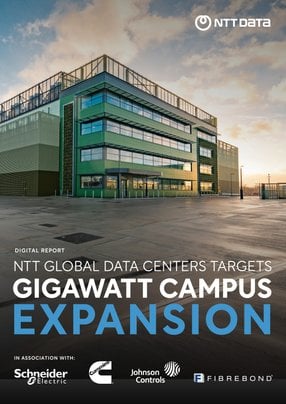
NTT Global Data Centres Targets Gigawatt Campus Expansion
The data centre industry is experiencing its most dramatic transformation in decades, driven by AI workloads that demand unprecedented power densities and cooling capabilities.
Traditional enterprise facilities that once consumed 10-15 kilowatts per rack are being replaced by AI-optimised installations requiring 100 kilowatts or more, forcing changes in everything from electrical infrastructure to construction methods.
At the centre of this transformation is Brittany Miller, SVP of Global Infrastructure Development at NTT Global Data Centres (GDC), who has overseen a remarkable scaling of operations during her five-year tenure.
In that time, the company has moved from building modest facilities to planning gigawatt campuses that rival the electricity consumption of medium-sized cities, while simultaneously navigating supply chain challenges, sustainability requirements and the technical complexities of liquid cooling systems.
NTT GDC operates within NTT DATA’s broader infrastructure portfolio, which includes cloud services, networks and managed IT solutions alongside data centre facilities. “NTT DATA offers not only data centres but cloud, networks, cloud services and managed IT under one umbrella that helps us provide solutions for our clients end-to-end across the globe,” Brittany explains.
NTT delivers gigawatt expansion across seven strategic markets
The scale of NTT GDC’s current expansion is one example of how technology companies today approach infrastructure investment. The company is adding nearly one gigawatt of capacity across seven strategic markets, representing a deliberate choice to build substantial capacity in proven markets.
The company’s North American expansion is largely focused on two major developments. The Hillsboro, Oregon facility will reach 350 megawatts when construction completes, while the Mesa campus in Phoenix will reach combined capacity exceeding 300 megawatts. International expansion, meanwhile, has focused on Milan, Paris, India, and Tochigi in Japan.
The company’s international expansion strategy balances global standardisation with local market adaptation. Operating across more than 20 countries, NTT GDC provides scale advantages while maintaining regional expertise required to navigate diverse regulatory environments.
“We have the global scale that very limited players have, but we also have that local knowledge,” says Brittany. “NTT as a whole operates in over 20 countries. But each data centre campus is designed with the local market’s regulations and our client expectations in mind. We have a standard design and a standard product so that the look and feel of the data centre is the same across the world. But we’re able to tailor it for each market.
“Because we have such a large footprint, we’re able to help our customers along that journey,” she continues, “whether they’re used to building their own and want the same look and feel across the globe.”
AI driving an infrastructure revolution
It’s no secret: AI has created the most significant technical disruption the data centre industry has experienced.
Traditional enterprise applications typically require 5-10 kilowatts per server rack, power levels that conventional air cooling systems can manage effectively. AI training and inference workloads demand power densities that have forced fundamental reconsideration of cooling systems, electrical infrastructure, and facility design.
“That changed everything from how we design our data centres to the power that supports our data centres to the locations we look at,” Brittany explains. “You’ve seen our densities grow from 10-15 kilowatts to 60 kilowatts to 100 kilowatts, and projected to go higher as we scale.”
The industry-wide nature of this transformation has forced unprecedented collaboration between stakeholders that traditionally operated independently. Equipment manufacturers must coordinate with construction contractors, while utility providers accommodate power demands that exceed traditional data centre loads.
“It’s forced some things to happen in the industry – we can’t be siloed,” she adds.
“It’s a supply chain in itself. That’s forced a lot of collaboration and some out-of-the-box thinking. Using AI in our industry for our own benefit has happened. It’s really changed dramatically in the last five years,” Brittany observes.
The timeline of change has compressed dramatically, with fundamental infrastructure modifications occurring within months rather than years.
“Things like automation, modularity, power and sustainability are no longer optional. How do you solve this complex puzzle with those types of things? That’s where the industry is now,” she notes.
Customer collaboration shapes AI infrastructure development
The complexity of AI infrastructure requirements has moved customer relationships beyond traditional capacity planning into collaborative technology development partnerships. To cite one example, NTT Global Data Centers has deployed substantial liquid cooling capacity over the past two years while engaging customers in forward-looking planning processes.
“How do you power high density? How do you support it from an infrastructure perspective?,” Brittany asks. “We’ve been focused on that and have been able to deploy quite a bit of liquid cooling capacity over the last year or two, which has accelerated the way we're thinking about the product and where the market is going.”
The collaborative approach extends to strategic planning for AI technology evolution.
“That’s one thing that we’re partnering with most of our customers on. What does their future-looking roadmap look like? How do we get ahead of that? That's one of the biggest trends,” she continues.
Customer preferences have reinforced the importance of global infrastructure providers capable of supporting AI deployments across multiple regions simultaneously.
“What I’ve also seen from the more mature, broader clients is they want global players – a company that has that global footprint to be able to react to their demand changes as well,” Brittany notes.
Environmental sustainability has transitioned from voluntary corporate responsibility to a fundamental business requirement. NTT Global Data Centers has established net zero targets (Scope 1-3) for 2040 with intermediate carbon neutrality goals for 2030.
“We’re approaching that with three different strategies,” Brittany says. “The first one is reducing our direct emissions through different alternative fuels, minimising generator testing and those types of options. Our second strategy is procuring renewable energy. Our third strategy is engaging with our suppliers – and that’s part of my organisation. How do we, as a supply chain, work towards decarbonisation?” Brittany summarises.
“In FY23, our previous fiscal year, we were able to reduce our emissions by 25% compared to our previous years,” she adds. “We’ve also got over 50% of renewable energy usage. Even with those challenges, we've still made a lot of progress on our goals.”
AI tools transform NTT GDC’s construction operations
Beyond supporting AI workloads for customers, NTT is implementing AI applications across its own construction and operational processes.
Construction sites employ AI-powered monitoring systems that analyse project progress through computer vision technology, identifying potential delays or quality issues before they impact schedules or budgets.
“We are piloting multiple tools to help us ensure quality and schedule and cost delivery. We are using AI on the job site to track the progress of projects and understand where we might have issues. We’re piloting different AI scheduling to help us, particularly in some regions that are not used to this type of scale and don't have that type of experience,” Brittany explains.
Modularisation and prefabrication initiatives benefit from AI capabilities, especially in markets experiencing skilled labour shortages.
“We’re also looking at things like how do we modularise or prefab more things, using AI, particularly in markets where there are labour shortages. All of the development and the broader construction industry is working through how to leverage AI. We’re trying to pilot and work through in different regions what works for us. That’s what we've been focused on the last year – building that culture of innovation and seeing what tools are out there.”
Strategic partnerships enable innovation and delivery
The complexity of modern data centre development has elevated strategic supplier partnerships from transactional relationships to collaborative planning arrangements. The collaborative model emerged from necessity during 2020, when supply chain disruptions forced closer integration between operators and suppliers.
“I think the whole industry figured out very quickly that partnerships are where this industry needs to go, and it accelerated that for us,” Brittany reflects.
The partnership strategy builds on standardised design approaches while providing suppliers with strategic planning information. “At NTT GDC, we have a standard design that we use across the globe, which helps us with our customers’ time to market. On top of that, we are able to partner with people like Cummins and Schneider Electric and JCI to look forwards.
“They have access to our roadmap years forward, so that they can plan accordingly. They help us with getting prepared for a new market and engineering based on what they’ve seen across the world. Recently, with all the high-density changes, having these partnerships has enabled us to pivot quite quickly and leverage some of those partners to accelerate some of our builds,” she explains.
Generator systems represent one of the longest lead time items in construction schedules.
“Cummins is one of our generator suppliers, and they’re focused across the Americas and different regions. They’ve been with us for quite a bit of time. We work with them closely given generators are probably one of the longest lead items in the data centre industry,” Brittany emphasises.
People-focused leadership drives team development
Brittany’s management philosophy emphasises human relationships and team development, recognising that successful projects depend on effective collaboration across all stakeholder groups.
“The most simple leadership principle that I lead from is it’s about the people – particularly in construction. It takes everybody, from the people that are building it to the people that are managing it to the end client. I always focus on the people, and it guides our culture at NTT Global Data Centers,” she explains.
“I’ve been at NTT Global Data Centers now for five years, and when I came here, the goal was to develop a high-performing team to build and scale our business. We’ve done that. The output of that is being able to see people excel in their careers and be confident and capable and move on to global roles and different types of things in their career. That’s the real win out of all of this,” she reflects.
The final months of 2025 will see NTT GDC balancing capacity expansion with technology advancement. The company will continue gigawatt-scale development while opening data centres in new markets and refining high-density designs deployed across 100 megawatts of US capacity.
“We’ll continue to leverage and build to one-plus gigawatts across the globe,” Brittany says. “You’ll see us open data centres in new markets. You’ll see us refine and continue to deploy our high-density design.
“We’ve deployed over 100 megawatts of high-density design in the United States, and that’s going to continue across the globe,” she concludes. “We’re also partnering with different customers for future-looking things. You'll see a lot of innovation out of NTT, but then also a lot of delivery on what we say from a time-to-market perspective, because at the end of the day that's what the clients are looking for.”
Company portals


Executives

Brittany Miller
SVP VP Design Construction, and Supply Chain