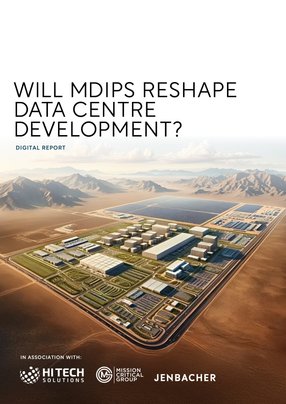
Will E3 Platforms’ MDIPs reshape Data Centre Development?
Spencer Viernes, CEO, and Rhea Williams, Chief Commercial Officer, launched E3 Platforms (E3) two years ago to address a widening gap between power supply and demand in the data centre sector.
The company develops what it calls Master-Planned Digital Infrastructure Parks (MDIPs) – large-scale industrial developments that combine land development, power generation and digital infrastructure on sites spanning over 1,000 acres.
"Our core mission is to deploy a business model that benefits the digital infrastructure industry, especially where it sits today," says Spencer.
“There’s a huge gap between where the supply of power capacity is and where the demand for it is – all while balancing that with the needs of the communities in which those digital infrastructure developers would deploy those specific projects.”
The company emerged from recognition that traditional development models no longer serve the data centre industry's needs. Rhea was working in Europe when power constraints began appearing in Frankfurt, Amsterdam and London. Virginia started experiencing similar issues around the same time.
"Spencer came to me three years ago now, almost, and saw that there was going to be a gap in where the utility had always been able to provide a load letter and supply the energy needed for the data centre," Rhea says. "We had originally come in thinking that we would be building data centres and going to be supplying a small bit of behind-the-metre power to bridge the gap until the utility was able to meet us. But things have grown exponentially and changed in the industry since that inception."
E3 Platforms addresses infrastructure complexity beyond power generation
The scale of modern data centre development now affects municipal planning in ways few anticipated. A 500MW campus requires more than power generation – it demands water treatment facilities, road infrastructure capable of handling heavy lorries and comprehensive resource aggregation.
"A lot of these territories that can deploy 500MW of power, you're going to have to build your own water treatment plant," Spencer says. "And so now we're expanding the amount of municipal services that we have to contemplate and plan for from a framework perspective as developers."
Spencer, who practised law before entering the data centre sector, points out that the development team must now consider services typically provided by municipalities. The company essentially plans to build infrastructure for what functions as a small city within a geographically constrained area.
E3 maintains a lean structure with Spencer and Rhea as the core team, supplemented by partnerships across different verticals. This approach allows rapid decision-making while bringing in expertise the founders do not possess internally.
"You are looking at the original E3 entire team," Rhea says. "We've added a little bit over the last couple of years, but we are very lean, which allows us to be very agile, which means that Spencer and I can make decisions very quickly, which is great. But partnership is paramount for us."
Master Planned Digital Infrastructure Parks combine economic development and energy infrastructure
E3's Master Planned Digital Infrastructure Parks rest on three pillars: economic development, energy and environmental sustainability.
These elements form what the company describes as a framework for long-term community transformation rather than isolated industrial development.
Traditional economic development metrics often fail to resonate with local elected officials in rural communities. These jurisdictions typically lack the internal staff to conduct input-output economic modelling common in metropolitan areas.
"To say to the community, ‘Hey, for every dollar we spend here in the community, there's going to be $6 additional economic development in this community’, is all well and good,” says Spencer.
“Yes, you can point to PwC reports or McKinsey reports. But a lot of these communities don't even have the internal staff to do traditional input-output economic modelling that you would see from a large metropolitan area. But they want things in plain English: show me real jobs that are coming into my community."
Spencer prefers to present the opportunities accessibly, in ways local communities can support.
"The schools will get bigger, the community colleges, the trade schools, the local tradesmen and contractors will all grow to such a significant degree," Spencer says. "It's not just about expanding broadband access and connectivity, which it is, but it's about creating the foundational elements that allow for true sustainable development across decades, not just years."
The company also considers environmental sustainability beyond carbon capture. Initial fuel sources will likely be natural gas, but E3 plans for nuclear power as regulatory frameworks develop. The scale of these parks allows consideration of district heating systems that could provide industrial customers and local residents with heat waste.
E3 Platforms works with Mission Critical Group and Jenbacher on Utah project
The company's approach requires partners with expertise across multiple technical verticals. Rhea describes how E3 evaluated different technologies and original equipment manufacturers before selecting partners for its Utah project.
"Jenbacher's been a tremendous partner," Rhea says. "We looked at different technologies and different OEMs, and what the timelines were, what the costs were, and what their team's availability was, and Jenbacher, by far and away, has become and shown up as the best partner, the most supportive of what we're doing."
The partnership with Jenbacher includes a teaming agreement with guaranteed delivery dates and fixed costs. The company selected Jenbacher's reciprocating engines based on efficiency considerations for the Utah site's high altitude and low humidity conditions.
"They've also worked with us from an architecture and engineering standpoint on their side, have been looking at the load variants and how to best support these AI loads, and we feel like we've chosen the product of theirs that's going to support that the best," Rhea says.
Mission Critical Group serves as the systems integrator for the project. The company has introduced E3 to other participants needed to deliver what Rhea describes as a turnkey solution.
"Matt Coffel and his team have been integral for us in that they have introduced us to a lot of those key players that I was talking about when it comes to partnership and us needing to develop a turnkey solution," Rhea says. "They have come in as our systems integrator. They'll help us build the switchgear, and they're going to be a vendor of ours, but they've also become a liaison, if you will, to all of the other necessary components and partners that we're going to need to deliver that turnkey solution."
Hi Tech Solutions partnership positions E3 Platforms for long-term power generation
E3's partnership with Hi Tech Solutions reflects planning for energy infrastructure beyond the initial deployment phase. Hi Tech Solutions, a partner company to Holtec, provides operations and maintenance services for nuclear facilities across North America.
"Hi Tech Solutions is a partner company to Holtec, the nuclear company. They do the operations and maintenance as a services-based company for Holtec, as well as other nuclear developments that are here in the United States," Rhea says.
Spencer notes that Hi Tech Solutions maintains a strong team for deployment, labour, staffing and operations across the nuclear industry's existing operating fleet. The partnership combines E3's land development expertise and data centre relationships with Hi Tech Solutions' nuclear operations capabilities.
"We see what they bring to the table, and we all intend for these facilities to be nuclear-backed one day, when the regulatory and other elements come together and we're able to rely on those systems," Rhea says. "It's a perfect sort of partnership of they do what we don't, and we do what they don't."
The companies are developing a joint venture that would combine expertise in land development, municipal services deployment and nuclear operations to create parks that transition from natural gas to nuclear power as regulatory frameworks permit.
E3 Platforms addresses data centre industry's community engagement challenges
Rhea identifies what she calls a marketing problem within the data centre industry. Communities increasingly view data centres as isolated consumers of water and energy that provide limited local employment despite tax revenue contributions.
"We have historically, and you see this tremendously in Loudoun County (Virginia), and now certainly in Phoenix, built data centres that the community saw as isolated water and energy takers that didn't provide a lot of jobs,” says Rhea.
“Data centres may have given back tax revenue, but we've come to a bit of a not-in-my-backyard sentiment," admits Rhea.
The scale of modern data centre development requires co-location with complementary industrial and manufacturing facilities. A gigawatt campus generates demand for warehousing, structured cabling, containerisation and other supporting industries.
"When we talk about a gigawatt, can you imagine how much warehousing that's going to need? How many plugs? How much structured cabling you're going to need in order to actually do that?" Rhea asks. "So there's a tremendous amount of industry, structured steel, cement and containerisation, that's going to be needed in order to support these data centre campuses."
The company's MDIPs allocate land and power for these associated industries while building out municipal services including water treatment. This approach creates what Rhea describes as community growth that supports the grid network through interconnection.
E3 Platforms develops hybrid investment structure for power and land development
E3's business model combines two traditionally separate investment frameworks: merchant land development and power generation. This structure reflects the absence of traditional utility capacity letters that would have simplified land development in previous decades.
Spencer argues that fewer than 50 data centre developers currently possess the capability to develop a 1,000-megawatt campus worldwide. Yet thousands of industrial users require 5 to 15 megawatts of power capacity. All face the same interconnection queue constraints.
"The land developer, or somebody within this ecosystem, has to take on multiple business models, at least one of which they haven't traditionally had to take on," Spencer says. "For E3 and for the MDIPs, we're taking on the land development business model, which is generally lower cheque size, but also relatively quicker turnaround from an investment time horizon. Plus, we're having to take on the municipal services or the utilities development business models."
The land development component offers higher returns with higher risk and shorter time horizons. The utility services component provides stable returns over longer periods with different capital requirements. These distinct characteristics allow E3 to structure investments in separate buckets that align with different investor profiles.
"Bringing those together really solves a very significant solution, and the numbers at scale are so large, you can articulate those from a financials perspective without having to do some super novel technology," Spencer says.
The company spent considerable time developing frameworks that allow clear articulation to investors about where they enter the development process, how they achieve returns and when they exit. This work involved what Spencer describes as numerous rabbit holes to develop understanding and communicate it effectively to different investor types.
E3 Platforms plans five projects across Utah, Wyoming and Idaho
The company does not view other developers as competition in a market that requires widespread capacity addition. Rhea says E3 will be successful if it can set an example which sets a precedent for the industry.
"There is so much to go around. We don't see that there's heavy competition and view it adversarially," Rhea says. "We hope that what we do is duplicated across the United States. We're not going to build dozens of these MDIPs for the foreseeable future. But we do want to get them right to inspire industry innovation."
The company avoids calling these developments microgrids because the scale ranges from 2-4GW. As these parks develop in rural communities and interconnect with the grid, they support public utilities across the US.
Spencer characterises the data centre industry's challenges around community engagement and public-private partnership as advocacy gaps rather than marketing problems. The industry remains young compared to traditional industrial verticals such as energy.
"The data centre industry, it's like a baby elephant. Elephants are huge, lots of weight, very significant. But the data centre industry is a baby in comparison to traditional industrial verticals, like energy," Spencer says.
The company's mission centres on creating what Spencer describes as win-win-win scenarios. E3 hopes other developers will adopt similar frameworks for their projects.
"There is a lot of headroom, and I hope we are not the only folks that start developing digital infrastructure in this way. I hope that there are others that latch onto this and do this in other communities, because I think that's an amazing and an absolutely positive thing if they do," Spencer says.
Rhea emphasises the data centre industry's role in driving renewable energy deployment. She cites how the major cloud providers – Microsoft, Google, Meta and Amazon Web Services (AWS) – provided the capital that established wind and solar capacity across the United States.
"I think that necessity-driving invention is going to push us towards nuclear faster because of this exponential growth in AI, and I think that that's going to transform the country in how we all consume and use power, and makes everything much, much, much cleaner," Rhea says.
E3 expects to deliver electrons within 12 to 18 months. Spencer describes the opportunity facing the digital infrastructure industry as unique for creating material community impact.
"We are now in a time where digital infrastructure and the market participants in that industry are uniquely positioned to create win-win-win scenarios in the communities that we develop," Spencer says. "We have all the tools we need to take advantage of this opportunity and really do something materially impactful."
Company portals
Executives

Rhea Williams
Spencer Viernes
Chief Executive Officer