IEA launches Observatory for Data Centre Sustainability Push
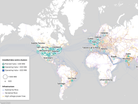
The International Energy Agency (IEA) has launched its Energy and AI Observatory, a platform designed to track the expanding relationship between AI workloads and energy infrastructure.
The observatory provides data on global data centre capacity, power consumption patterns and AI applications across the energy sector.
It addresses what the IEA identifies as a gap in comprehensive global statistics on data centre electricity consumption and provides estimates of data centre electricity consumption by region and across time periods.
This data becomes increasingly relevant as AI workloads require more processing power and energy resources.
Data centre investments have grown rapidly, with gigawatt-scale clusters emerging across North America, Europe and Asia Pacific. The IEA notes that AI is making data centres larger and more power-intensive, which raises the importance of electricity generation capacity and grid infrastructure in location decisions for new facilities.
LIkewise, existing infrastructure, policy frameworks and talent pools that enabled leading markets to develop have created momentum that continues to attract new data centre development.
This creates what the IEA describes as a need for grid operators and policymakers to understand how the data centre pipeline evolves.
IBM and Google contribute case studies to observatory
The observatory currently contains 19 case studies spanning buildings, industry, innovation, power, supply and transport sectors. These studies demonstrate how AI deployment across the energy sector improves efficiency, reduces costs, drives competitiveness, enhances innovation, integrates new technologies and builds resilience.
IBM Chief Sustainability Officer Christina Shim says she is “delighted that IBM contributed by sharing our work on the Electricity Access Forecasting AI model”. The model was co-developed by IBM and UNDP and built on IBM watsonx, IBM Cloud and an open-source machine learning library.
Christina explains that the model “projects electricity access through 2030 across 102 Global South countries by evaluating drivers like population density, existing grid and off-grid infrastructure, urbanisation rates, terrain elevation and night-time satellite imagery, augmented with land use data from IBM Environmental Intelligence”.
Google Chief Sustainability Officer Kate Brandt describes the observatory as creating “a single, comprehensive reference, gathering crucial data and providing a global, informed vision on the impact of AI on the energy sector”.
Kate notes that she is “delighted that two of Google's AI-powered solutions are featured” in the platform.
The solutions are:
MethaneSAT
Kate says: “Monitoring methane emissions at scale has been a major challenge in identifying and reducing their sources.
“Google’s partnering with the Environmental Defense Fund on a new satellite, MethaneSAT, which can detect methane emissions from oil and gas production more accurately and precisely than ever before.”
Tapestry
Kate says: “X‘s moonshot for the electric grid is using AI-powered tools to help partners like CEN, Chile’s national grid operator, make grid planning smarter, faster and easier to help achieve its ambitious goal of carbon neutrality by 2050.
“I'm excited to see the many applications of how AI is being used today and new additions to the observatory over time.”
Confronting a changing data centre pipeline
Among the case studies, Hitachi Energy’s work demonstrates how AI-driven probabilistic approaches can improve energy price forecasting accuracy.
The company applied machine learning algorithms to enhance prediction processes, with six teams testing various methods and 10 algorithms while reviewing data availability and algorithm tuning processes.
The processes and algorithms developed achieved 87% accuracy for CAISO locational marginal prices, 93% accuracy for MISO locational marginal prices and 86% accuracy for MISO ancillary service prices. This compares to the industry expectation of 75% accuracy for predicting hourly, real-time, wholesale energy prices in US markets.
These modelling framework enhancements and algorithms have been integrated into a forecasting software solution called Nostradamus AI, which enables users to generate forecasts without data science training requirements.
Ultimately, the IEA has developed the observatory with data and insights from energy industry and technology sector partners. The platform includes maps of global data centre capacity and power usage, alongside the case studies that outline different AI use models across various sectors.
The agency states that there has been “a step change in the capabilities of AI, driven by falling computation costs, a surge in data availability and technical breakthroughs”.
It adds that “there is no AI without energy; at the same time, AI has the potential to transform the energy sector”.
Explore the latest edition of Data Centre Magazine and be part of the conversation at our global conference series, Tech & AI LIVE and Data Centre LIVE.
Discover all our upcoming events and secure your tickets today.
Data Centre Magazine is a BizClik brand