
LightIC Brings Silicon Photonics FMCW LiDAR to Market—with Instant Velocity Awareness

LightIC’s production-ready Silicon Photonics (SiPh) based FMCW LiDAR delivers key attributes accelerating L3/L4 feature rollout. These include first frame full-vector velocity, >300 m highway range detection, software configurable resolution, immunity to degradation from sunlight and other LiDARs, scalability and cost effectiveness enabled by the AI-powered SiPh ecosystem.
SAN JOSE, Calif., Oct. 01, 2025 (GLOBE NEWSWIRE) -- LightIC, a pioneer in silicon photonics–based FMCW LiDAR, today announced the general availability of its automotive FMCW LiDAR, LARK. By combining Frequency-Modulated Continuous Wave (FMCW) technology with Silicon Photonics (SiPh) Chip integration, LightIC addresses critical safety gaps left by legacy ToF LiDAR and accelerates OEM roadmaps toward advanced driver assistance systems (ADAS) and L3/L4 autonomous driving. This milestone positions LightIC among the first companies worldwide to deliver scalable, mass-production–ready FMCW LiDAR for next-generation intelligent sensing.
Why This Matters: The Critical Safety Perception Gap
The automotive industry’s push toward L3/L4 autonomy has revealed a critical challenge: sensors developed for L2+ ADAS are inadequate for the safety and performance demands of higher automation. Time-of-Flight (ToF) LiDAR, the dominant technology in today’s perception stacks, estimates velocity through multi-frame tracking—a method inherently prone to latency, noise amplification in dense traffic, and failure when point clouds are sparse. These shortcomings pose serious risks in urban edge cases, such as suddenly opening car doors or pedestrians and objects appearing in a vehicle’s path. At highway speeds, the consequences are even more severe: a 1 second delay translates into a 30 meter blind spot.
Equally problematic is ToF LiDAR’s vulnerability to optical interference, whether from direct sunlight or from pulses emitted by other LiDARs. Another well-known issue is blooming: when highly reflective surfaces—such as safety cones, road signs, or warning boards, especially in wet conditions—cause channel crosstalk that makes objects appear much larger than they are. In these cases, ToF LiDAR may fail to detect lower-reflectivity objects or trigger false alarms. Such artifacts severely degrade perception quality. For automakers, these errors increase safety risks and complicate sensor fusion, making ToF a less viable option for L3 production programs.
Why This Matters: The Next Generation Sensor - FMCW
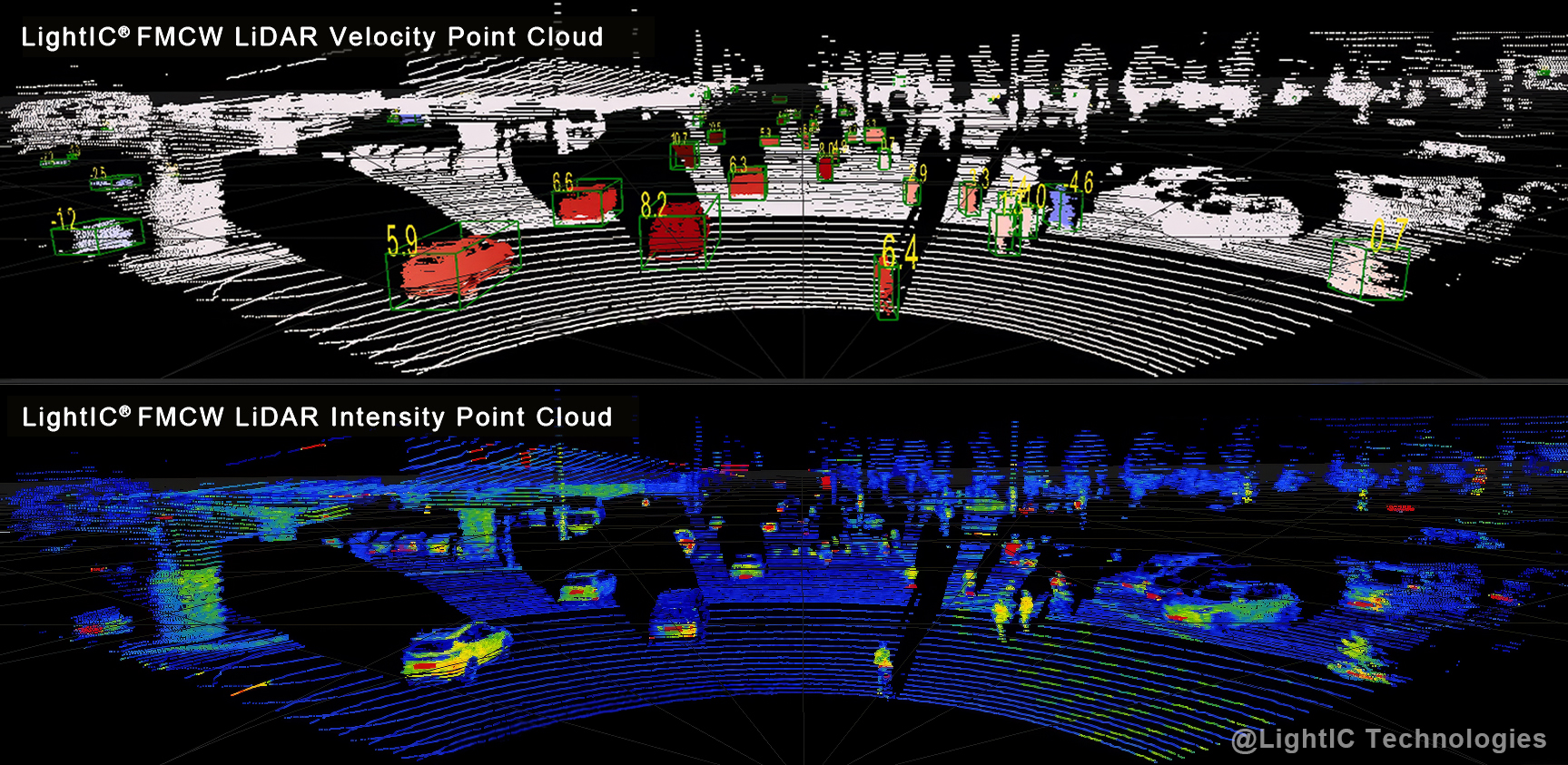
It’s time to choose the next-generation sensor. LightIC’s automotive FMCW LiDAR — LARK — delivers instantaneous, pixel-level velocity awareness. This additional dimension of velocity data dramatically reduces perception stack complexity and enables much faster response times in critical driving scenarios such as cut-ins and pedestrian crossings—a key benchmark for NHTSA safety ratings. Beyond velocity, FMCW delivers unmatched advantages over legacy LiDAR sensors: it can detect objects more than 500 m away with only two to three points (similar to a high-resolution imaging Radar but with far greater resolution) simultaneously computing full-vector velocity within a single frame; and resolving small objects with high accuracy and software-defined high resolution. By contrast, ToF LiDAR remains constrained by latency- and error-prone velocity tracking. With LARK, LightIC brings scalable, automotive-grade FMCW LiDAR to market—bridging the gap between today’s ADAS and tomorrow’s L3/L4 autonomy.
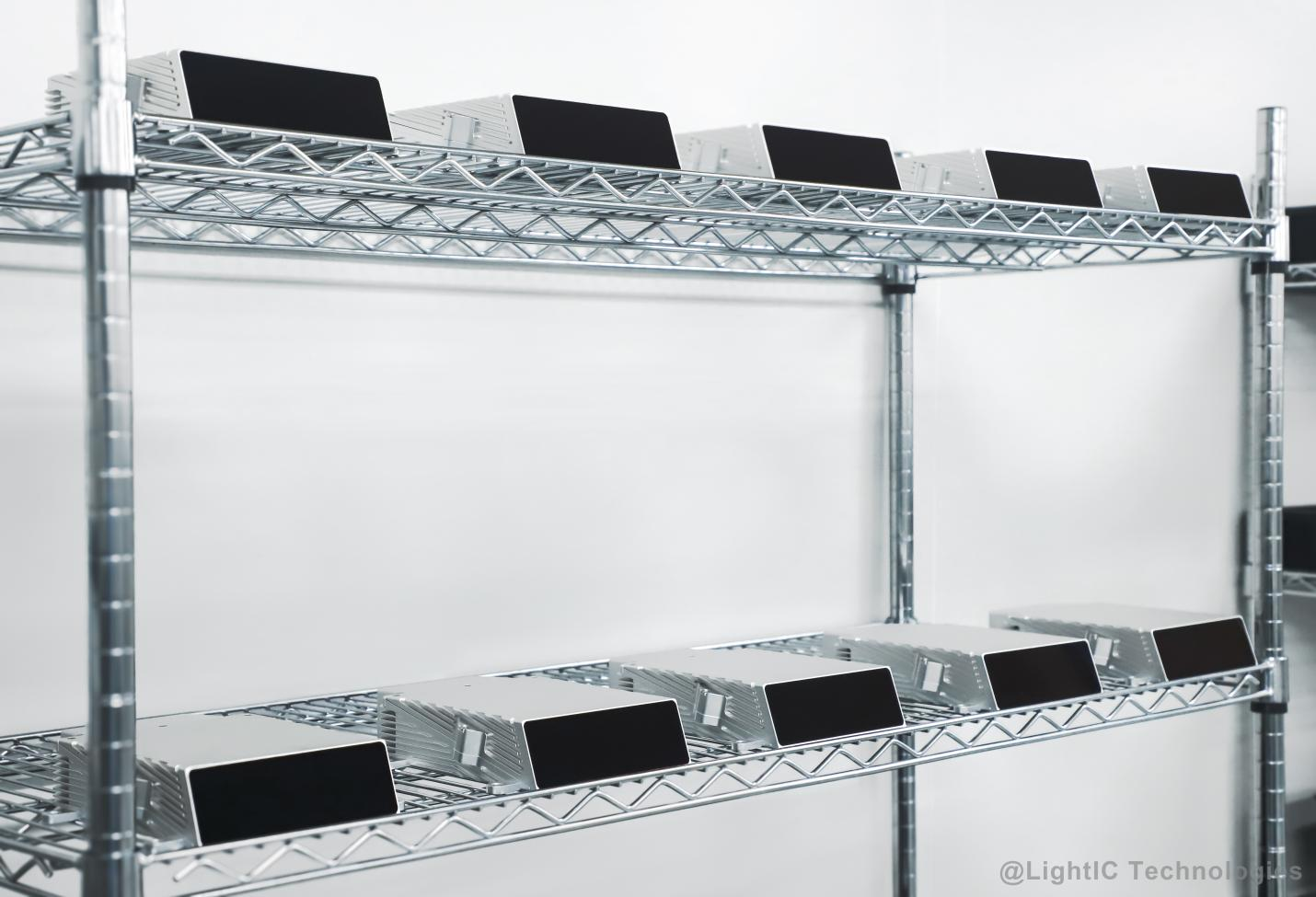
LightIC Automotive (4D) FMCW LiDAR — LARK
LightIC’s FMCW on SiPh is not just another sensor—it is an ADAS sensing platform evolution that elevates fidelity, reduces latency, and strengthens robustness across the perception stack. The result is safer, more reliable perception for OEMs’ next-generation ADAS and autonomy programs—delivered within budget.
“OEMs are increasingly prioritizing sensors that can future-proof perception systems. FMCW LiDAR’s unique ability to distinguish between static and dynamic objects not only simplifies sensor fusion but also reduces uncertainty for the planner,” noted a chief system architect at a leading global Tier-1 supplier. “LightIC’s silicon photonics platform delivers on three critical pillars—scalability, interference resilience, and deterministic velocity measurement. Together, these capabilities position FMCW LiDAR as the de facto standard for Level 4 autonomy.”
FMCW LiDAR, while recognized as a more advanced sensing technology, has long faced criticism for being expensive, bulky, and immature for mass production. This perception has shifted dramatically in recent years, accelerated by the global AI-infrastructure boom. The explosive demand for optical connectivity in AI datacenters has rapidly advanced the silicon photonics ecosystem, making it more mature, cost-efficient, and widely accessible. At the same time, co-packaged optics (CPO) has brought high-power, narrow-linewidth lasers into economical availability, while the once-costly LiDAR assembly process now benefits from the same high-volume production lines used for datacenter optical transceivers. In short, the AI boom has enabled a robust silicon photonics ecosystem—and FMCW LiDAR is a direct beneficiary.
By unifying frequency-modulated continuous wave (FMCW) sensing with a highly integrated SiPh process, LightIC has achieved a breakthrough: large numbers of Tx and Rx FMCW channels can now be integrated onto a single chip without the need for precise optical alignment. This enables velocity-resolved, long-range perception that is inherently interference-free and blooming free—ready for mass production. LightIC’s platform simultaneously measures distance and Doppler velocity at the pixel level, delivering a deterministic, low-latency perception primitive that downstream planning and control systems can rely on with confidence.
“General availability should mean more than just sampling—it requires proven reliability, robust calibration models, and a supply chain ready to scale,” said Dr. Sun, CEO of LightIC. “By bringing FMCW onto a silicon photonics platform, we transform breakthrough performance into a repeatable, scalable, automotive-grade product. OEMs can have confidence in assured supply and the ability to plan their programs with certainty.”

With next-generation mobility on the horizon and OEMs demanding faster, more reliable perception, LightIC’s FMCW LiDAR brings together the key capabilities needed to support advanced applications: instantaneous full-vector velocity, high-confidence detection beyond 500 m, software-configurable resolution, immunity to sunlight and cross-LiDAR interference, low latency, scalability, and cost efficiency. These capabilities not only empower OEM development programs but also accelerate deployment timelines. By leveraging strong OEM partnerships, real-world scenario validations, and expanded use cases, LightIC is establishing a practical benchmark for next-generation perception—enabling L3/L4 autonomy and paving the way beyond.
About LightIC Technologies
LightIC is a global leader in silicon photonics–based FMCW LiDAR for automotive, industrial automation, and robotics. The company integrates FMCW sensing and optical phased control on a proprietary SiPh platform to deliver long-range, interference-safe, velocity-rich perception at scale. LightIC is based in San Jose, California, with R&D, manufacturing and technical sales around the world.
Subscribe:
Instagram: https://www.instagram.com/lightic.technologies/
YouTube: https://www.youtube.com/@LightICTechnology
LinkedIn: https://www.linkedin.com/company/lightic-technologies-usa-inc/?viewAsMember=true
Contact:
Kristina Wang | Growth Manager
