
How Nvidia is Boosting Water Efficiency with Blackwell
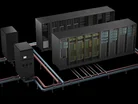
New liquid cooling technology for GB200 and GB300 NVL72 systems has not only provided cost reductions of US$4m per year, but also dramatically increased water efficiency, for a 50 megawatt (MW) hyperscale data centre.
As AI continues to grow in speed and scale, data centres are having to wrestle with enabling more compute for such dense infrastructure. This has created myriad sustainability challenges for data centres, particularly those that use traditional air cooling methods.
Whereas data centres once operated at 20 kW per rack, hyperscale facilities now support 135 kW per rack. This power density increase makes heat management a central concern for operators planning infrastructure upgrades to support AI workloads.
With this in mind, Nvidia has positioned itself in the centre of the global shift towards direct liquid cooling solutions. Its GB200 NVL72 systems address thermal management constraints that air cooling cannot overcome.
Likewise, they incorporate direct-to-chip liquid cooling that transfers heat through a technology cooling system loop.
“As compute density rises and AI workloads drive unprecedented thermal loads, data centres and AI factories must rethink how they remove heat from their infrastructure,” Nvidia shared last week in a press release.
“The traditional methods of heat rejection that supported predictable CPU-based scaling are no longer sufficient on their own. Today, there are multiple options for moving heat outside the facility, but four major categories dominate current and emerging deployments.”
The heat rejection evolution
Liquid cooling architecture cycles heat through a coolant distribution unit via liquid-to-liquid heat exchanger before transferring it to a facility cooling loop. Given such efficiency, data centres and AI factories can operate effectively with warmer water temperatures, Nvidia says, which reduces the need for mechanical chillers.
- 40x higher revenue potential
- 30x higher throughput
- 25x more energy efficiency
- 300x more water efficiency compared to air-cooled architectures
For hyperscale operators spending an estimated US$1.9-2.8m per megawatt per year, the impact on cooling costs proves substantial. By deploying liquid-cooled GB200 NVL72 systems, Nvidia says that data centres can achieve up to 25x cost savings.
Data centre cooling systems fall into four main categories that represent different approaches to heat rejection, according to Nvidia:
Mechanical chillers
These use a vapour compression cycle to cool water circulated through the data centre. These systems provide reliability across diverse climates but consume significant energy.
In AI-scale facilities where power consumption affects operational costs, reliance on chillers increases both expenses and carbon footprint.

Evaporative cooling systems
These systems leverage water evaporation to absorb and remove heat through direct, indirect, or hybrid designs.
While more energy-efficient than chillers, these systems consume millions of gallons of water per megawatt annually and perform less effectively in humid or water-restricted regions.
Dry coolers
Dry coolers are able to transfer heat from a closed liquid loop to ambient air using finned coils. These systems eliminate water usage, making them suitable for facilities in dry climates.
Their effectiveness depends on external air temperature and they may struggle with high-density cooling unless paired with liquid-cooled IT systems that tolerate higher operating temperatures.
Pumped refrigerant systems
Systems like this move heat from data centres to outdoor heat exchangers using liquid refrigerants without relying on large internal compressors.
This method provides a thermodynamically efficient solution for edge deployments and water-constrained environments, offering power and water savings despite requiring proper refrigerant handling.
Enabling high-performance GPUs for AI workloads
Nvidia has been making moves in the data centre industry in recent months to greater support developing AI workloads.
The leading chipmaker unveiled a comprehensive suite of data centre technologies at GTC 2025, which are designed to transform traditional computing facilities.
Supporting what Nvidia refers to as ‘AI factories’, the company’s announcements are designed to power the next wave of AI applications - particularly those that are focused on AI reasoning and agentic AI.
“AI has made a giant leap - reasoning and agentic AI demand orders of magnitude more computing performance,” says Jensen Huang, founder and CEO of Nvidia, during his keynote address at the event.
Industry partners have been developing liquid cooling infrastructure solutions that are optimised for Nvidia’s high-density AI systems.
- Vertiv’s reference architecture for NVIDIA GB200 NVL72 servers reduces annual energy consumption by 25%, cuts rack space requirements by 75% and shrinks the power footprint by 30%
- Schneider Electric’s liquid-cooling infrastructure supports up to 132 kW per rack, improving energy efficiency, scalability and overall performance for GB200 NVL72 AI data centres
- CoolIT Systems’ high-density CHx2000 liquid-to-liquid coolant distribution units provide 2MW cooling capacity at 5°C approach temperature, ensuring reliable thermal management for GB300 NVL72 deployments
- Boyd’s advanced liquid-cooling solutions include coolant distribution units, liquid-cooling loops and cold plates to further maximise energy efficiency and system reliability for high-density AI workloads
NVIDIA continues developing advanced cooling technologies through initiatives like the COOLERCHIPS program, a US Department of Energy-backed effort to create modular data centres with next-generation cooling systems. These are projected to reduce costs by at least 5% and improve efficiency by 20% compared to air-cooled designs.
The company said: “By embracing high-density architectures and advanced liquid cooling, the industry is paving the way for a more efficient AI-powered future.”
Moves like this also support the tech giant’s wider strategy to move the manufacturing of its AI supercomputers solely to the US, through strategic partnerships with the likes of TSMC and Foxconn.
Explore the latest edition of Data Centre Magazine and be part of the conversation at our global conference series, Tech & AI LIVE.
Discover all our upcoming events and secure your tickets today.
Subscribe to our Weekly Newsletter for the latest insights, trends and expert analysis.
Data Centre Magazine is a BizClik brand