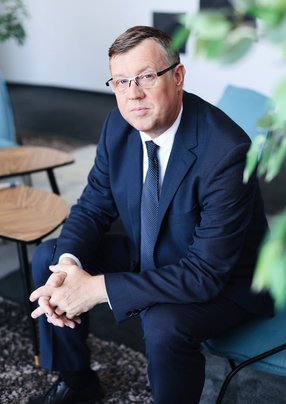

Andris Gailitis was fixing university servers in 1999 when most people had never heard of the Internet. As a technician at the Riga Technical University in Latvia, he had access to something that seemed almost magical – global computer networks that connected researchers across continents.
"I was born at the right time in the right place," says Andris, now CEO of Delska, the Baltic data centre group, currently in the process of completing a €30 million facility in Riga. "I started at a time when the Internet didn’t really exist, it only appeared as a word, if at all."
Back then, Internet access was restricted to universities and wealthy corporations. Students studying technical subjects found themselves with privileged access to technologies that would soon reshape the global economy.
Andris spent nights learning about networks and servers, unaware he was preparing for an industry that would soon take over the whole world.
The timing proved fortunate. As the Internet expanded beyond academic institutions, companies needed people who understood how to keep servers running and networks connected. Andris moved from the university to a municipal company, then joined a newly established hosting company in Latvia.
"Nobody could predict how these things would go," he says. "But the growth of IT technologies and the Internet was exciting."
Twenty-five years later, Andris runs a company that serves customers across multiple countries, positioning itself as a provider to both SMBs and global hyperscalers. The journey from university technician to CEO mirrors the transformation of IT from a supporting service to a critical infrastructure.
"When we started, IT technologies were helping other industries," explains Andris. "Now IT is becoming, in most countries, a critical industry itself, the same as hospitals, the same as banks."
This shift became even more transparent during the pandemic, when data centres kept the economy running whilst other infrastructure failed. Governments now treat data centres as essential services that cannot be allowed to fail.
Andris has maintained focus on the IT infrastructure throughout his career, resisting temptations to chase software trends or expand into adjacent markets. This discipline helped Delska survive multiple technology cycles and prepared it for the current AI boom.
"We are a pure infrastructure player, and we are doing the best we can with the experience we have," he says.
The approach proved prescient as AI applications began demanding dramatically higher power levels than traditional computing. Where standard hosting uses 10-20 kilowatts per rack, AI workloads can require up to 250 kilowatts, potentially even more.
"When it comes to AI, it's a complete disaster in terms of predictability," says Andris. "The customer can require 50 kilowatts, 100 kW, 250 kW, or more."
This level of unpredictability might overwhelm companies lacking deep infrastructure experience. Delska's new Riga facility uses modular design and dual cooling systems to handle both traditional and AI workloads without wasting capacity on unused infrastructure.
The facility planning and design reflects lessons learned over decades of operation. Rather than building separate facilities for different power requirements, Delska designed one site that can be scaled from 10 to 30 megawatts on the land owned next to the construction site, whilst supporting both air and liquid cooling.
Andris expects AI infrastructure demand to continue despite concerns about power consumption and grid capacity. Applications that seemed experimental five years ago now drive business operations across multiple industries.
"AI-capable data services will not go anywhere," he says. "They are here to stay." The regulatory environment is also changing as data centres gain critical infrastructure status. European Union directives are increasing compliance requirements, which affect operational costs across the industry.
"Data centre hosting is no longer a simple, cheap infrastructure service," says Andris. "This regulatory push is adding bureaucracy to services, which, unfortunately, also means an increase in prices."
Despite these challenges, Andris remains confident about the industry's direction. Companies that understand infrastructure and can adapt to changing requirements will find opportunities as hyperscalers outsource regional operations.
"You know, more than 30% of the resources needed by hyperscalers are currently being outsourced," he says. "So, I believe we are in the right place, at the right time."
"We have a lot of things to do, and we are very optimistic," says Andris.
To read the full story in the magazine, click HERE.