
Building Sustainable Liquid-Cooled AI Data Centres

AI isn't just a technology shift. It’s a full-scale, unstoppable energy revolution.
Here, Andrew Bradner, Senior Vice President, Cooling Business at Schneider Electric offers his expert insights into this profound transition.
A single AI query uses roughly ten times the electricity of a typical internet search, and demand is climbing at lightning speed. Projections suggest data centres could account for approximately 3% of total global electricity consumption by 2030, nearly doubling their current share and growing four times faster than electricity consumption from all other sectors.
That kind of power is creating heat like never before, and it’s a thermal challenge legacy data centres weren’t built to handle. Traditional air cooling is being pushed to its limits by high-performance, high-density racks, and to unlock AI's full potential, data centres must move beyond the status quo and embrace advanced, sustainable liquid cooling.
The Shift to High-Density, Liquid-Cooled Infrastructure

AI workloads are breaking the mold and pushing rack power densities to new norms. Current rack densities can range from 40 kW to well over 100 kW, which is impractical to manage with air cooling. Demands continue to climb rapidly, with each new generation of GPU-accelerated servers. Today’s fully populated NVIDIA-based GPU racks draw around 132 kW and are projected to reach 240 kW per rack within a year, and the industry is preparing for future power densities of 1 MW per rack.
Unlike standard Central Processing Units (CPUs), Graphics Processing Units (GPUs) and other AI accelerators generate intense, concentrated heat loads requiring targeted, highly efficient cooling to maintain optimal performance.
This is where liquid cooling becomes mission critical. Direct liquid cooling is up to 3,000 times more effective at removing heat than air because it captures heat directly at the chip-level.
Liquid cooling at scale: the sustainability equation
As workloads grow, liquid cooling is emerging as the most sustainable path forward. It can cut energy use by 30-60% and eliminate water consumption altogether, providing efficiency gains adiabatic air cooling simply can’t match. These savings directly translate into carbo footprint reductions.
However, liquid cooling’s broader adoption requires deeper consideration of several data centre design and operational levers impacting sustainability:
- Energy use: Next to IT systems, the cooling system is the second-biggest energy consumer. Design factors such as site selection, climate, and IT inlet fluid temperatures determine energy efficiency.
- Water use: The liquid loop is closed, so racks do not consume water directly. Operating at higher temperatures reduces reliance on outdoor water for heat rejection.
- Greenhouse gas (GHG) emissions: The carbon footprint is mainly driven by energy consumption, especially in fossil-fuel-based grids.
- Coolant toxicity: Safe operations and responsible disposal remain critical for closed-loop systems.
Designing for sustainability
Installing liquid cooling is a great first step, but true sustainability stems from smart design and operations:
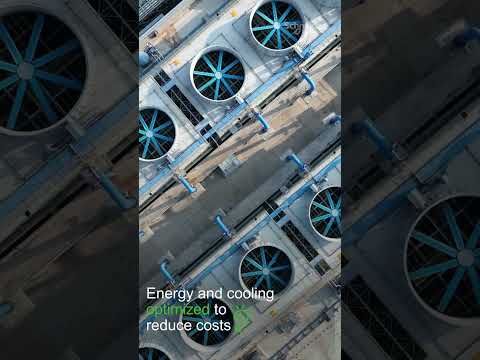
- IT inlet fluid temperatures: Raising rack temperatures can cut energy use by roughly 40% and outdoor water use by 40-60%.
- Heat rejection type: Air-cooled chillers with economiser modes rely on ambient air and near-zero water use, unlike water-intensive cooling towers.
- Component selection: High-efficiency pumps, heat exchangers and coordinated control systems minimise operational energy.
- Heat re-use: Liquid cooling enables reuse of higher-grade heat for district heating or industrial processes.
A blueprint for future-proofing AI infrastructure
Moving to liquid cooling requires careful planning and a forward-looking strategy. Here’s a practical blueprint to follow:
- Plan in parallel: Coordinate physical infrastructure and IT planning to avoid delays.
- Design for flexibility and scalability: Support hybrid setups and future direct-to-chip cooling.
- Partner early and often: Collaborate across IT vendors and system integrators. The collaboration between Schneider Electric and NVIDIA on reference designs exemplifies this.
- Embrace sustainability as a core requirement: Align cooling strategies with ESG goals and regulations.

Bottom line: liquid cooling is mission-critical for the AI era
At Schneider Electric, we believe that data centres are the factories of the future and together with Motivair by Schneider Electric, we are proud to have unveiled the industry’s first portfolio of end-to-end liquid cooling solutions - purpose-built for the demands of next-generation AI data centres.
In a world powered by AI and GPUs, liquid cooling is no longer optional - it’s a cornerstone of competitive advantage, driving performance, sustainability, reducing energy and water consumption, carbon emissions, and supporting higher rack densities.
With over 12 years of proven success cooling the world's leading high-performance computing (HPC) environments, and deep-rooted expertise within the most advanced supercomputing systems, we are delivering unmatched reliability, efficiency and sustainability for the AI Factories of the Future.
Company portals

Executives

Andrew Bradner
Senior Vice President, Cooling Business