Chasing Efficiency: The Data Centre’s Role in the AI Era
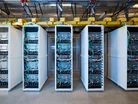
Booming demand for AI and cloud services is fuelling a rapid build-out of data centres, with hyperscalers such as Meta, Google and Amazon racing to deploy ever larger campuses.
These facilities are energy-intensive, forcing operators and utilities to explore ways to keep up with demand while maintaining resilience.
Some experts argue that efficiency offers a more immediate solution than building new generation capacity.
By optimising cooling, chip performance and power delivery, data centres can extract more compute from each megawatt already available.

Efficiency as a strategic priority
Speaking to the FT, Steven Carlini, Schneider Electric’s VP of Innovation and Data Center Solutions, explains the shift in focus is clear.
“There’s a limited amount of available power, but the more efficiently they can use that power, the more capacity they can build,” he says.
While operators have always pursued efficiency for cost reasons, the scale of today’s AI workloads is pushing them to treat it as a strategic necessity.
Liquid cooling takes centre stage
AI chips generate intense heat as they process trillions of calculations for large language models and image recognition. Until recently, air cooling dominated, but it is becoming less viable as densities rise.
Liquid cooling systems are gaining traction because liquids are denser and more effective at absorbing heat.
Amazon, for instance, is rolling out custom solutions using “cold plates” placed directly on top of chips, with liquid flowing through to remove heat.
“We’ve crossed a threshold where it becomes more economical to use liquid cooling to extract the heat,” says Dave Klusas, AWS's Senior Manager of Mechanical Solutions.
“You don’t want to overcook the liquid going into the chips, so we’re always adjusting and optimising the temperatures,” Steven Carlini adds. “That’s new because running at these types of densities, at this scale, is really challenging for the industry.”
AI-driven monitoring tools are also being applied, allowing operators to adjust conditions in real time to balance cooling performance with energy use.
Gains through chip innovation
Beyond cooling, efficiency gains are being driven by the chips themselves. Nvidia, Groq and other designers are delivering higher-performance semiconductors that use less energy per computation.
Research from the Rand Corporation and Epoch AI examined 500 AI supercomputers and found a 1.6-times annual improvement in performance per chip between 2019 and 2025. Computational performance per watt also rose by 1.34 times per year.
Yet the report’s author, Project Specialist Konstantin Pilz, tells the FT that progress is becoming harder to achieve.
“Chips are the main thing that could improve and energy efficiency, which companies are aware of,” he says. “But they’re still very power hungry.”
Tackling power delivery losses
Another area of focus is reducing the energy wasted as electricity flows through a data centre. As power is stepped down from high-voltage inputs to server components, significant losses occur.
Thar Casey, Founder and CEO of AmberSemi, says as much as 50% can be lost in transfer to the motherboard. His company is developing semiconductors that cut waste by 15% using “vertical power delivery”, where chips receive power from underneath rather than laterally.
“Each 1% of energy loss represents about US$460m per year,” Casey said. “We’re talking about serious money, and that’s only in the US.”
Flexibility and demand response
Researchers at Duke University have highlighted another potential lever: large load flexibility. By reducing or shifting usage during grid stress, data centres could ease pressure on supply.
Their study found US grids could support 76 GW of new load if operators curtailed demand for just 0.25% of annual operating hours.
“Necessity is the mother of invention,” says report author Tyler Norris to the FT. “We have extreme supply chain constraints right now, so either [the demand] will disappear entirely or it can be more flexible.”
Google has already piloted demand-response measures, signing agreements with utilities in Indiana and Tennessee to tackle data centre consumption.
Discussing the latter project, Kate Brandt, Chief Sustainability Officer at Google, called the project historic.
“In a landmark agreement, Google has teamed up with Kairos Power and Tennessee Valley Authority to help deploy the Hermes 2 Plant, a new advanced nuclear reactor, in Oak Ridge, Tennessee.
“To build clean and resilient energy systems, we need strong communities. This collaboration aims to help to revitalise the Oak Ridge community's legacy of nuclear innovation, create high-paying jobs and provide educational opportunities through partnerships with the University of Tennessee and other local colleges.
“This work is such a great example of the power in bringing together technology, business and community, three key components to solving the biggest challenges of our time.”
The paradox of efficiency
Despite these efforts, some analysts warn that efficiency alone will not curb demand growth.
The Jevons paradox suggests that efficiency gains may simply enable more consumption, as companies increase the capacity of their platforms and users flock to more demanding models.
Konstantin Pilz reflects on the challenge: “If I’m using ChatGPT and I have the choice between the most advanced model or like a generation behind, I prefer to use the most advanced model,” he tells the FT. “And I think that’s why, despite these efficiency improvements, we still see this large increase in compute and power demand.”
For now, efficiency remains both an opportunity and a necessity.
As AI accelerates, operators are betting that technologies from liquid cooling to advanced semiconductors can stretch limited resources while keeping their data centres competitive.