How NTT DATA Builds Cybersecurity into Data Centres

NTT DATA is making a clear play to hard‑wire cybersecurity resilience into the fabric of modern data centres through a new global network of AI‑powered Cyber Defense Centers.
The company has several next‑generation facilities in India, the UK, and US – with its global coverage spanning five continents.
These centres are designed from the ground up to protect cloud and AI‑heavy environments at scale, reflecting how security has shifted from being a bolt‑on control to a core pillar of data centre strategy.
At the heart of NTT DATA’s model is a move away from traditional, centralised security operations towards a distributed, AI‑driven architecture that learns continuously from incidents and analyst input.
This approach aims to cut investigation times by up to 60% and reduce alert volumes by as much as 90%, allowing security teams to focus on higher‑value response and recovery work rather than manual triage.
The expansion reflects NTT DATA's strategic commitment to modernising cybersecurity for the AI era, where traditional security models struggle to keep pace with the speed and sophistication of emerging threats.
Agentic AI and autonomous SecOps
The new Cyber Defense Centers are built around agentic AI for SecOps, where software agents autonomously triage, analyse and hunt for suspicious activity across customer environments.
By automating repetitive, high‑volume tasks, these agents push many SOC workflows towards autonomy, while still looping in human specialists for complex forensic analysis, containment and post‑incident review.
Industry research suggests this trend is set to become mainstream. Omdia forecasts that autonomous Security Operations Centers will be the industry standard within two years, positioning NTT DATA as an early mover in the transition to agentic platforms for cyber resilience.
This is particularly relevant for data centres grappling with AI‑driven attacks, where machine‑speed adversaries demand machine‑speed defence aligned to operational realities on the ground.
"Our clients' innovation and growth are driven by rapid adoption of cloud and AI technologies that must be secured at speed and scale," says Charlie Li, Head of Cloud and Security Services at NTT DATA.
"Our expanding footprint of next‑generation Cyber Defense Centers enables us to meet the rising demand for AI‑powered cybersecurity services, defend against AI‑enabled threats and help our clients advance their edge‑to‑cloud digital transformation journeys."
The centres leverage what NTT DATA describes as GenAI‑driven threat orchestration, enabling security teams to contain threats earlier in the kill chain. This proactive stance represents a fundamental shift from reactive incident response to predictive threat hunting powered by real‑time intelligence and historical pattern analysis.
Global intelligence, local risk context
A defining feature of NTT DATA’s cyber strategy is the way it blends global threat intelligence with local regulatory and risk context.
The company now supports more than 1,200 clients worldwide with 24x7 unified monitoring, detection, response and incident management delivered through a single SecOps dashboard.
Each Cyber Defense Center layers regional threat hunting and compliance expertise onto this global backbone, helping organisations address diverse privacy rules and AI‑specific regulations while maintaining consistent controls.
The centres operate in close collaboration with regional Computer Emergency Response Teams and National Cyber Security Centres, as well as relevant government agencies.
This “glocal” model is particularly important for data centres supporting critical infrastructure and sovereign cloud workloads, where operators must align to national resilience frameworks while benefiting from worldwide indicators of compromise and attack patterns.
"Today's threat environment demands intelligent, adaptive defences that combine global insight with local expertise to help organisations continuously reduce risks and build resilience," says Sheetal Mehta, Executive Managing Director & Global Head - Cybersecurity Services at NTT DATA.
"With the addition of these AI‑powered Cyber Defense Centers, we are advancing our vision of a globally interconnected cyberdefence network that combines cutting‑edge technology, strategic partnerships and world‑class talent."
The integration with NTT DATA's broader SecOps global network – spanning more than 40 delivery centres and SOCs across over 50 countries – means threat intelligence flows bidirectionally. Local centres feed regional threat patterns into the global system, while simultaneously benefiting from worldwide attack data and defensive strategies.
Data centres under AI‑age pressure
NTT DATA's investment reflects growing pressure on operators as AI and cloud adoption accelerate.
The centres are purpose‑built with cutting‑edge technology designed to address the specific challenges facing modern data centre operators. Key capabilities include autonomous agent‑based cyberdefence that accelerates detection and response cycles, real‑time threat intelligence tailored to each region's unique threat landscape, and proactive identification of emerging threats alongside clear visibility of cyber risks.
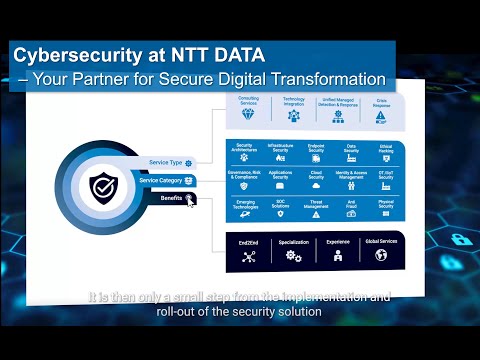
The comprehensive service portfolio spans Managed Detection & Response, Incident Response, Threat Intelligence, Compliance & Regulatory Advisory and Cloud & OT Security Services – addressing the full spectrum of data centre security requirements from edge to core infrastructure.
This aligns with broader concerns across the digital infrastructure ecosystem that cybersecurity risk is now an existential issue, not a niche technical topic.
For enterprises navigating rapid digital transformation, the ability to secure AI workloads and cloud infrastructure at scale has become critical. The centres are designed to support this imperative, helping clients maintain security posture as they expand their digital footprint across hybrid and multi‑cloud environments.
Embedding resilience into infrastructure
For data centre owners, the message is that cyber resilience must be engineered into infrastructure rather than retrofitted.
NTT DATA's offering spans Managed Detection and Response, incident response, threat intelligence, compliance and regulatory advisory and cloud and OT security – all of which are converging on the data centre as a strategic control plane.
By building these capabilities directly into global operations, the company is trying to give clients a clearer view of cyber risk and a roadmap for reducing it through continuous detection, protection and recovery.
The expanded network of Cyber Defense Centers also adds capacity for more than 800 security analysts worldwide, enabling NTT DATA to scale human expertise alongside automation.
This focus on people echoes wider industry concern that talent shortages and gaps in security culture are now among the most serious inhibitors of digital transformation, particularly where AI and software‑defined infrastructure are in play.
The centres leverage strategic partnerships with industry‑leading technology platforms, enabling NTT DATA to deploy best‑in‑class tools whilst maintaining the flexibility to adapt to evolving threat landscapes and client requirements.
For clients, the benefits extend beyond threat detection. The AI‑powered platforms enable organisations to navigate regulatory change with confidence, build long‑term digital trust and accelerate edge‑to‑cloud transformation whilst continuously protecting expanding digital ecosystems.

Advancing a globally interconnected defence network
NTT DATA's leadership frames the new Cyber Defense Centers as the next step in building a globally interconnected cyber defence network that combines technology, strategic partnerships and specialist talent. The company argues that as adversaries adopt AI and autonomous tactics, enterprises need equally adaptive platforms to maintain digital trust and support secure growth across hybrid data centre and cloud environments.
For data centre operators planning 2025 and beyond, the direction is clear: resilience is moving from the SOC screen into the physical and logical design of facilities, from how workloads are segmented to how incident response is orchestrated at global scale.
The shift towards autonomous, AI‑driven security operations represents more than technological evolution – it signals a fundamental reimagining of how data centres approach cyber resilience in an era where threats move at machine speed and digital infrastructure underpins nearly every aspect of business operations.
As NTT DATA's network of Cyber Defense Centers becomes operational, the model offers a template for how global enterprises can balance the need for unified security controls with the reality of diverse regional requirements, all whilst harnessing the power of AI to stay ahead of increasingly sophisticated adversaries.
Company portals
Executives
Charlie Li
President, Global Head of Cloud & Security

Sheetal Mehta
Executive Managing Director & Global Head - Cybersecurity Services