Meta Pushes Mass Timber for Data Centre Construction
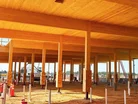
The construction of data centres depends on carbon-heavy materials such as steel and concrete, placing pressure on operators to rethink how facilities take shape.
Meta is now working on new ways to build data centres, focusing on how sustainable infrastructure supports growing digital demand without relying on traditional methods.
It is advancing two materials that could reshape sustainable construction: mass timber and low-carbon concrete.

In 2024, Meta announced the construction of a new data centre in Aiken County, South Carolina in the US.
Once it is fully built, the site will mark the company’s 22nd data centre in the US and the 26th globally, covering 715,000 square feet.
More than US$800m is going to be invested in the project, which will support around 100 jobs.
What sets the site apart is the materials used in its construction, as Meta has chosen wood in place of conventional steel and concrete elements in parts of the build.
Devon Lake, Head of Net Zero Strategy at Meta, says: “When people think about data centres, they think servers and energy demand.
“They rarely think about the buildings themselves and the embodied carbon locked into every ton of steel and concrete poured during construction.
“Building the infrastructure for AI doesn’t have to mean building the same way we always have.”
Mass timber in data centre design
Mass timber is a core element in Meta’s strategy to reduce embodied carbon, which is the total greenhouse gas emissions linked to materials and construction.
It refers to engineered wood products such as cross-laminated timber and glue-laminated beams, designed for industrial-scale use while maintaining structural strength.
Meta has worked on pilot projects using mass timber across several data centre campuses, including locations in South Carolina, Wyoming and Alabama.
These projects focused on administrative buildings first, where the company recorded about 41% lower embodied carbon compared with conventional materials.
The material’s lower weight changes how foundations are designed. Because mass timber structures weigh less than steel or concrete, they reduce the need for deep concrete foundations by up to 50%. This directly lowers emissions tied to cement production and transport.
Mass timber also addresses fire safety and durability concerns in data centre environments through its density and its ability to form a protective char layer when exposed to fire.
This slows combustion and maintaining structural integrity. Its strength-to-weight ratio can exceed that of steel, making it suitable for demanding environments.
Blair Swedeen, Global Head of Net Zero and Sustainability at Meta, says: “Sustainably sourced mass timber is a great fit for us because it has much lower embodied carbon than traditional materials like steel or concrete. Using mass timber helps us build in a way that’s better for the environment.
“We’re continuing to actively explore mass timber not only in our administrative buildings but also in warehouses and critical data halls, the spaces that house servers.
“Mass timber’s strength, durability and fire resistance makes it a promising candidate for broader applications within data centre infrastructure and we continue to evaluate these opportunities.”
Rethinking concrete in digital infrastructure
While mass timber offers an alternative to steel in some applications, concrete is also an essential for data centre construction. Cement production alone accounts for around 8% of global emissions, making it a major target for reduction efforts.
Meta is substituting traditional cement with alternatives such as fly ash – a byproduct from coal combustion used to improve concrete performance while lowering carbon intensity. This substitution cuts emissions by up to 20% below regional baselines.
Design changes also reduce reliance on concrete. By removing concrete from electric and telecom duct banks, which are the underground systems that carry power and data cables, and replacing it with gravel fill, projects cut emissions further.
Meta is also deploying an AI model using adaptive experimentation toolboxes, which are systems that test and refine variables automatically, to optimise concrete mixtures.
This system enables emissions reductions of up to 70% in concrete mixes without compromising durability or safety.
As data demand grows through cloud computing and AI, infrastructure expansion continues at pace.
Meta’s work with mass timber and low-carbon concrete shows how construction methods evolve alongside operational efficiency, bringing the physical layer of data centres into sharper focus.
Company portals

Executives

Blair Swedeen
Devon Lake
Head of Net Zero Strategy