
Starcloud: US$170m to Spur Shift to Data Centres in Space
Starcloud has secured US$170m in funding and reached a US$1.1bn valuation as it develops orbital data centre infrastructure designed to address AI’s growing power demand. Led by Benchmark and EQT Ventures, the round reflects rising interest in alternatives to land-based facilities as energy constraints shape the future of compute.
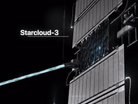
The company is positioning its Starcloud-3 satellites as modular data centre nodes in low Earth orbit, where solar generation and thermal management operate under different conditions to those on the ground. As AI workloads expand, operators face limits in land availability, energy pricing and cooling capacity, prompting new approaches to infrastructure design.
Orbital data centres and the cost equation
The move into orbit centres on what Starcloud describes as a critical cost crossover. According to the company, falling launch costs, supported by heavy-lift rockets such as SpaceX Starship, have begun to align with the rising expense of building and operating terrestrial data centres.
Starcloud CEO Philip Johnston explains the technical challenge directly, stating that orbital infrastructure is “brutally difficult to execute”. Philip outlines a model that strips data centre architecture to core components, focusing on compute, energy generation and thermal control.
By concentrating on chips, solar panels and cooling systems, the company targets an energy cost of around US$0.05 per kWh.
On Earth, operators must balance land acquisition, grid capacity and environmental impact. Cooling alone accounts for a large share of energy use, often requiring water-intensive systems to maintain safe operating temperatures for GPUs.
In orbit, these constraints change. Solar panels operate without atmospheric loss and are not limited by local daylight cycles in the same way as fixed terrestrial installations.
This allows more consistent energy generation. Cooling, while complex in a vacuum, uses passive radiators that emit heat as infrared radiation, removing the need for water-based systems.
Starcloud-3 as a modular compute node
At the centre of the strategy is Starcloud-3, a three-tonne satellite designed to deliver 200kW of power.
Philip describes the satellite as a “stripped-down” platform. It integrates solar panels for energy, high-performance chips for processing and optical terminals for data transmission.
Meanwhile, optical terminals refer to laser-based communication systems that transfer data between satellites or ground stations at high speed.
Unlike traditional satellites that combine multiple functions, Starcloud-3 operates as a dedicated compute node. It connects to third-party broadband networks for data transfer, separating compute from connectivity.
Rather than producing one-off systems, Starcloud builds units in-house at specialised facilities, aiming for repeatable, high-volume output. This approach aligns with how hyperscale providers deploy server racks and prefabricated modules to accelerate expansion.
The satellite’s design also fits within the payload capacity of SpaceX Starship, supporting a deployment model that scales through batch launches rather than individual missions.
Scaling to a distributed data centre in space
Starcloud’s long-term plan extends to a constellation of up to 88,000 satellites. Combined, these units form what the company describes as a 5GW distributed data centre. In practical terms, this represents a network of compute nodes operating together, similar to a hyperscale campus but spread across orbit.
The concept of a distributed data centre here refers to infrastructure that is not confined to a single physical location. Instead, compute resources are spread across multiple sites or nodes, connected through high-speed networks to function as a unified system.
Starcloud has demonstrated early progress with an orbital test involving an NVIDIA H100 GPU. This chip supports AI training and inference, meaning it can both build machine learning models and run them in production. The test confirms that core data centre workloads can operate in space.

Future iterations, including Starcloud-2, are set to integrate NVIDIA Blackwell chips and AWS server blades.
As energy demand continues to shape data centre strategy, Starcloud’s model introduces a new layer of infrastructure that sits beyond terrestrial limits while maintaining compatibility with current technologies.
Company portals

Executives
Philip Johnston
Co-Founder & CEO
