The Google Innovations Unlocking Data Centre Efficiency

Power grids, planning permissions, water usage – the public conversation around data centres has become a swirl of figures and projections, often stripped of context.
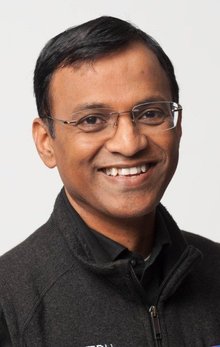
For Partha Ranganathan, Google VP and Engineering Fellow, that missing context is the problem.
A pioneer in data centre design who has spent more than two decades shaping the infrastructure that underpins modern computing, Partha has watched the narrative surrounding data centres grow louder – and, he argues, less accurate – just as the technology itself has never been more consequential.
In the “Anatomy of a Data Center” episode of Where the Internet Lives – Google and Latitude Studios' award-winning podcast and documentary series – Partha takes stock of where data centre design stands at the start of what he calls the “intelligence revolution”, and makes the case that high performance and sustainability are not in conflict.
Emergence of the warehouse-scale computer
Partha's career began not in data centres but in mobile phone efficiency. When concerns about data centre energy consumption surfaced in the late 1990s alongside the early internet boom, he saw an opportunity to apply what he learned from designing power-efficient handsets to a much larger problem. What followed was a shift in how he – and eventually the industry – thought about the data centre itself.
"Thinking about the data centre as a computer has a lot of really nice properties," he says, "because you can simplify a lot of the complexity that comes in and you can truly design a data centre for scale. That scale changes everything."
Rather than a room full of individual servers, the warehouse became the machine. Servers became components. Software became the operating system. That conceptual shift, Partha explains, is what enabled the cloud to grow while consuming orders of magnitude less energy than 1990s forecasts predicted.
Today, that same systems-level thinking is being applied to AI – a workload that is fundamentally different from the search queries and video streaming that once dominated Google's fleet.
"If you're asking a question of Gemini, fundamentally it's math heavy, it's incredibly big, data heavy," Partha says. "And it changes the nature of compute, memory, networking – which are the three key elements that you look at when you design a system."
The shift has driven rapid adoption of custom silicon accelerators, processors designed specifically for machine learning workloads. Partha helped architect Google's own accelerators, which he says can deliver significantly better energy efficiency than traditional CPUs – a contribution recognised, unexpectedly, with an Emmy Award in 2024 for work on video transcoding chips that transformed streaming.
The four levers for AI energy efficiency
The energy demands of AI have attracted scrutiny, not all of it well-founded in Partha's view. He does not dismiss the concerns outright – he describes them as legitimate – but he argues that many of the figures circulating in public debate lack the context needed to interpret them meaningfully.
"I think we see a lot of discussion in the news about worrying about the impact of AI on the power grid, on our carbon footprint," he says. "And I think there are legitimate concerns that we need to be very responsible about, thinking about energy efficiency for AI. But honestly, some of the claims are sensationalised a little too much in my mind."

He points to concrete progress as evidence. The AI-generated search summaries that now appear in Google Search became ten times more energy-efficient in the space of a single year. "We haven't even begun to scratch the surface of things that we can do," he says.
Partha identifies four areas where further gains are available. The first is accelerators: custom silicon, he says, can be orders of magnitude more efficient than general-purpose processors.
The second is the model itself – lighter, more task-specific versions of a given model, such as Gemini Flash compared to Gemini Pro, can dramatically reduce the energy cost per query.
The third is system design, where liquid cooling offers significant efficiency improvements over traditional air cooling.
The fourth is workload scheduling – moving compute tasks to where and when cleaner energy is available on the grid, an approach Partha describes as "following the sun."
The challenge is acute because the pace of change in AI is outstripping the pace of efficiency improvements that data centre engineers have historically relied upon. "We are talking about the models growing at a factor of two every three months, versus compute traditionally growing at a factor of two every two to three years," he says. "And so that disparity is profoundly challenging, which means we all have to up our game."
AI as a solution to AI's own demands
Compounding that pressure is the slowdown of Moore's Law. The reliable doubling of transistor density that underpinned decades of performance and efficiency improvements is flattening out. "Whether you look at performance per compute or energy efficiency of compute, or cost of memory or cost of storage, every one of those, which used to be on a nice exponential improvement curve, has started plateauing," Partha says.
That is where AI itself enters the picture – not as the source of the problem, but as part of the solution.
Partha describes three specific applications. AI is tuning cooling systems in real time and adjusting performance based on workload and ambient conditions. It is scheduling compute jobs to coincide with periods when lower-carbon energy is available on the grid. And it is beginning to transform chip design itself – a process that traditionally takes two years from concept to deployment and costs hundreds of millions of dollars.
"Can I use AI to speed up chip design?" Partha asks. "It turns out that the answer is yes. AI can profoundly transform chip design. Every aspect of chip design can benefit from using AI to accelerate and amplify the process."
Challenging the water guzzler narrative
Water consumption is the other axis around which data centre criticism has coalesced. Here too, Partha argues that the reporting has frequently misrepresented the underlying data – conflating water intake with water consumption, for instance, in a way that inflates apparent usage by a factor of around a hundred.
"We take water in and we give water back," he says. "It's really the water that's consumed that's important, not just the water that's taken in."
When consumption rather than throughput is the measure, Partha says the comparison changes substantially. "Many data centres use the same amount of water that a typical golf course would use, or even if you look at the most aggressive projections of AI, the water usage would be comparable to what a large company would consume."
His broader argument is that the public debate is measuring cost without measuring benefit. Drug discovery, weather forecasting, materials science, climate modelling – the applications Partha points to are tangible. AlphaFold, the protein-folding model developed by Google DeepMind, has already mapped nearly the entire set of known proteins, compressing what might have taken decades of laboratory work into days.
"Being able to accelerate this billion years of research on protein folding into a few days, a few months, now opens up the possibility for us to think about how humanity can benefit, how humanity can solve diseases that haven't been solved," he says.
For Partha, the failure is one of framing. "I do feel that the narrative misses those trade-offs in some respects," he says. "There is a lack of holistic discourse and discussion around how AI power consumption and data centre power consumption and water usage translates in terms of the big picture."
The intelligence revolution, as he sees it, is not a story about energy guzzlers. It is a story about compute as the foundation of a new era of scientific and societal progress – one that, in his view, has barely begun. "If you get a chance to be part of something that cures cancer, why would you not work on it?"
The new, fourth edition of "The Data Center as a Computer: Designing Warehouse-Scale Machines" by Luiz André Barroso, Urs Hölzle and Parthasarathy Ranganathan (released late 2025/early 2026) focuses on the evolution of Google's data centres for the AI era. It covers new case studies, four new chapters and the integration of AI-driven infrastructure.
Company portals

Executives
Partha Ranganathan
VP and Engineering Fellow