
Keynote: Rolls-Royce PS on Power Challenges in the AI Era
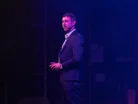
Perhaps one of the biggest challenges facing data centre professionals is how to manage their power in the age of AI.
As hyperscale facilities scale up to support compute-intensive workloads, data centre operators are under pressure to secure reliable energy sources while balancing efficiency and sustainability.
Opening the first day of Data Centre LIVE: The London Summit, Vittorio Pierangeli, the SVP Rolls-Royce Power Systems, explored this idea during his keynote speech.
First, he discussed how the increase of overall power demand for data centres is driven by electrification and AI growth.
"Power is the main bottleneck today for the realisation of data centre infrastructure. The typical construction timeframe for data centres is 18 to 24 months," he said.
"But the big bottleneck here is the availability of power infrastructure," he added.
"We are seeing the lead times to get grid connection in several jurisdictions globally increasing to five to seven years.
"In many regions, there is no availability of grid power until 2031, 2032. And so this is becoming a key bottleneck for operators that has operators to continue on their development plans."
The power challenge: disruptions in global supply chains
Vittorio also spoke about how geopolitical events are affecting global supply chains of gas, energy and power, as Iran's closure of the Strait of Hormuz continues.
According to the BBC, 20% of the world's oil and liquefied natural gas passes through the Strait of Hormuz.
"We see geopolitical issues in global wars increasing the need for energy security and energy independence, which is triggering investments on a global scale."
AI demands continuous uptime
The need for reliable backup power is becoming one of the defining challenges of the AI data centre era.
With facilities handling dense AI workloads, there is a need to maintain near-continuous uptime.
Vittorio added how expectations for availability sit at 99.995% for Tier IV classification, which is the highest standard for data centre resilience and fault tolerance, set by the Uptime Institute.
Discussing the main challenges facing AI data centres from a power perspective, Vittorio said: "First, there is the need for backup power.
"There is a target for Tier IV from Uptime Institute – 99.995% availability.
"There are backup power solutions available, immediate targets, but the market is becoming really congested at this point."
Looking at regional trends, Vittorio Pierangeli said China’s hyperscalers, including Tencent and Alibaba, continue to expand aggressively, with growth sitting at around 15%.
He also noted that APAC has, for the first time, overtaken Europe as a larger market after a slowdown in European projects across 2025 and 2026.
However, he expects Europe to rebound strongly in 2027 and 2028 as delayed developments restart, warning that new bottlenecks are already beginning to emerge across the region.bo
How onsite power generation is critical
Another major challenge for AI data centres is the growing need for prime power as grid connection delays continue to worsen.
Vittorio explained how operators are turning towards onsite generation to work around infrastructure bottlenecks and accelerate deployments.
"There is an opportunity for data centre operators to get around the bottleneck in the grid by installing their own onsite power plant, onsite generation," he said.
Vittorio added that while traditional industrial demand for continuous gas power remains relatively stable, AI-driven data centres are now fuelling significant growth in the market for gas-based prime power systems.
He noted that gas is being explored as an alternative to diesel for backup systems because it offers operators greater flexibility: a sign of how rapidly power strategies are evolving in the AI era.
However, with global supply constraints, the future of AI data centres will depend not only on technological innovation, but on how effectively the industry can solve its growing power challenge.
Company portals

Executives
Vittorio Pierangeli
Senior Vice President Global Power Generation