What Role do Data Centres Play in NVIDIA’s US$5tn valuation?

In October, NVIDIA became the first company in history to reach a valuation of US$5tn. While the milestone reflects surging demand for AI, it is NVIDIA’s central role in global data centre infrastructure that underpins the company’s rapid ascent.
After crossing US$3tn in June 2024 and US$4tn in July 2025, the company added another trillion dollars in value within three months.
That growth has been driven by hyperscalers, enterprises and governments investing heavily in AI data centres built around NVIDIA’s GPUs, networking and software platforms.
From graphics to data centre dominance

NVIDIA’s transformation from a graphics specialist into a data centre powerhouse has been central to its valuation trajectory. The company’s data centre business now sits at the core of global AI infrastructure, powering large language models, analytics platforms and real-time AI services.
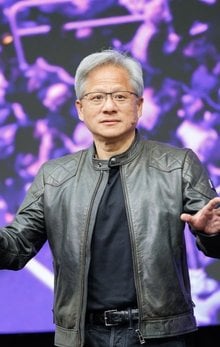
Founder, President and CEO Jensen Huang has linked the company’s momentum directly to sustained infrastructure demand. He has announced US$500bn in AI chip orders through 2026, driven by hyperscalers including Microsoft and Oracle, which together invested more than US$549bn in AI data centres during 2025.
Jensen tied this demand to NVIDIA’s product roadmap, stating plans to “deliver a total of US$500bn from Rubin and Blackwell in 2025 and 2026”, significantly boosting data centre GPU revenue.
“We are going through a platform shift,” Jensen says.
“That shift is a once-in-a-lifetime opportunity for us to get back into the game for us to start innovating with American technology.”
Speaking at GTC Washington DC, Jensen highlighted partnerships spanning supercomputing, autonomous vehicles and next generation networks, all anchored by large scale data centre deployments.
Hyperscale AI and telecom convergence
NVIDIA’s data centre platforms are increasingly extending beyond traditional cloud environments into telecom and edge infrastructure.
A US$1bn partnership with Nokia focuses on 6G development using the NVIDIA Aerial RAN Computer, built on Grace CPUs, Blackwell GPUs and Mellanox networking.
This approach brings data centre-class compute into radio access networks, blurring the line between core facilities and distributed infrastructure.
Justin Hotard, President and CEO of Nokia, says: “The next leap in telecom isn’t just from 5G to 6G, it’s a fundamental redesign of the network to deliver AI-powered connectivity, capable of processing intelligence from the data centre all the way to the edge.”
This convergence expands the role of centralised facilities as anchors for distributed AI workloads rather than isolated compute islands.
Edge platforms reshaping data centre architectures
NVIDIA’s edge platforms, including Jetson and EGX, have become extensions of the data centre rather than replacements for it. These systems handle inference and real-time processing close to data sources while remaining tightly coupled to central AI factories.
Jetson modules deliver computer vision and robotics workloads at low power, while EGX integrates CUDA with Kubernetes to support hybrid edge-cloud deployments in safety critical environments. The Aerial RAN Computer applies the same model to telecom base stations.
Jensen’s strategy positions edge deployments as part of a broader AI factory concept, with data centres providing training, orchestration and lifecycle management.
Energy efficiency is a key factor. BlueField-4 data processing units are designed to offload networking and security tasks, improving overall data centre efficiency while supporting dense AI workloads.
Industrial and autonomous use cases
NVIDIA’s data centre and edge platforms are already being deployed across industrial and mobility sectors. Seagate has implemented NVIDIA EGX for automated disk inspection, achieving reported throughput gains and rapid return on investment by identifying defects beyond human capability.
In autonomous mobility, NVIDIA’s Drive Hyperion and Cosmos platforms are being used to support Uber’s plans for 100,000 Level 4 autonomous vehicles by 2027. These systems rely on centralised AI training in data centres combined with distributed inference at the vehicle level.
Dara Khosrowshahi, CEO of Uber, says: “NVIDIA is the backbone of the AI era and is now fully harnessing that innovation to unleash L4 autonomy at enormous scale, while making it easier for NVIDIA-empowered AVs to be deployed on Uber.
“Autonomous mobility will transform our cities for the better and we’re thrilled to partner with NVIDIA to help make that vision a reality.”
Government and enterprise AI infrastructure
Beyond commercial deployments, NVIDIA’s data centre technologies underpin national research and enterprise AI systems. The company is equipping seven US Department of Energy supercomputers and integrating NVQLink to connect quantum processors with GPUs using CUDA-Q.
Palantir is also deploying NVIDIA’s CUDA-X and Nemotron models within its Ontology platform.
“Palantir is focused on deploying AI that delivers immediate, asymmetric value to our customers,” says Alex Karp, Co-Founder and CEO of Palantir Technologies.
“We are proud to partner with NVIDIA to fuse our AI-driven decision intelligence systems with the world’s most advanced AI infrastructure.”
As data centres evolve into AI factories supporting everything from national research to real-time industrial systems, NVIDIA’s position at the centre of that ecosystem explains how the company reached a valuation no other technology firm has yet achieved.
Company portals





Executives

Alex Karp
CEO
Dara Khosrowshahi
CEO
Jensen Huang
Founder and CEO
Justin Hotard
President and CEO