Can Old Aeroplane Engines Powering Data Centres Take Off?

Data centre developers are encountering delays in obtaining power as the demand for generative AI drives rapid expansion. Construction projects are straining existing energy infrastructure and utilities face long connection queues.
Traditionally, these sites draw electricity directly from the grid or use onsite generation. However, both options are being constrained by limited gas-turbine availability and slow regulatory processes.
Repurposed engines fill data centre power gaps
At the Data Center World Power show in San Antonio, ProEnergy, a natural gas power provider, introduced an alternative approach – repurposing retired aviation engines for power generation.
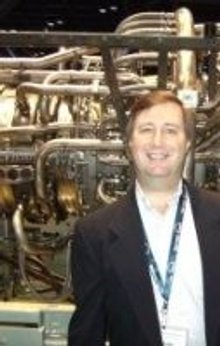
According to Landon Tessmer, Vice President of Commercial Operations at ProEnergy, the company’s PE6000 gas turbines are already deployed at several sites to provide power during construction and early operations.
“We have sold 21 gas turbines for two data centre projects amounting to more than 1GW,” says Landon.
“Both projects are expected to provide bridging power for five to seven years, which is when they expect to have grid interconnection and no longer need permanent behind-the-meter generation.”
This approach gives developers temporary energy capacity while avoiding years-long delays associated with grid connections or the procurement of new turbines.
The equipment either transitions to backup duty once grid connections are complete, supplements supply, or is sold to local utilities.
From jet turbofans to aeroderivative power
The conversion of aircraft engines for stationary power use is a long-established practice among gas-turbine manufacturers.
Companies such as GE Vernova and Siemens Energy have created product lines based on aeroderivative turbines – engines originally developed for aircraft but modified for industrial power generation. These machines are lighter and more modular than heavy-frame turbines, characteristics that make them easier to deploy and maintain.
Mark Axford, President of Axford Turbine Consultants, says: “It takes a lot to industrialise an aviation engine and make it generate power.”
Mark explains that the process involves reengineering components such as the turbine section to produce rotational shaft power instead of thrust, designing new fuel systems, and developing controls suitable for stationary operation.
GE Vernova’s LM6000, for example, evolved from the CF6-80C2 turbofan first introduced in 1985. The transition required redesigning multiple systems, including the combustor, to enable use of natural gas and achieve reduced emissions of nitrogen oxides.
Paul Browning, CEO of Generative Power Solutions and Former Head of GE Power & Water, said: “There just aren’t enough gas turbines to go around and the problem is probably going to get worse.
“Waiting times for new LM6000 or Siemens SGT-A35 models can extend from three to five years, with popular variants taking even longer. In contrast, “a PE6000 from ProEnergy can be delivered in 2027.”
Inside the PE6000 turbine programme from ProEnergy
ProEnergy’s solution repurposes the same GE CF6-80C2 cores used in the LM6000. These engine cores form the foundation of the company’s PE6000 system, delivering up to 48MW enough to supply a small-to-medium-sized data centre or a town of roughly 20,000 to 40,000 households. With around 1,000 of these aircraft engines expected to be retired in the next decade, supply of usable cores remains plentiful.
Each core undergoes complete disassembly, cleaning, inspection and reassembly to restore all parts to as-new condition. Components that cannot be reused are fabricated to ProEnergy’s specifications.
“We can overhaul the high-pressure core of any CF6-80C2 and fabricate all the low-pressure components,” Landon says.

The company standardises its installations into two-turbine blocks, each including generators, cooling systems, selective catalytic reduction for emissions control, and supporting electrical infrastructure. This uniform design reduces complexity in assembly and maintenance.
Originally intended for utilities requiring additional capacity during peak hours, the turbines are now used as primary sources of power for new data-centre projects.
The PE6000 can start in five minutes and be replaced within 72 hours if maintenance is needed. Emission levels average 2.5 parts per million for nitrogen oxide – significantly below the US Environmental Protection Agency’s range of 10 to 25 ppm for typical installations. ProEnergy has built 75 of the units since 2020, with another 52 now under assembly or on order.
Grid delays drive demand for temporary power
Demand for ProEnergy’s systems is partly driven by persistent delays in transmission-line permitting and construction.
Developers face approval processes stretching across municipalities and states, extending the timeline for grid interconnections to eight or ten years in some cases.
“Aeroderivative gas turbines are gaining ground as a bridging technology that runs behind the meter until the utility is able to supply grid power,” Landon says.
The combination of grid constraints, long turbine manufacturing lead times and sustained growth in AI compute infrastructure has made transitional power sources an established part of the data-centre construction model.
Landon said, “Aeroderivative gas turbines are gaining ground as a bridging technology that runs behind the meter until the utility is able to supply grid power.”
If existing bottlenecks in the grid and turbine supply chain continue, bridging generation could become an integral phase of data-centre planning.
Company portals


Executives
Landon Tessmer
VP, Commercial & Business Development - EPC
Mark Axford
Owner