
How Big is Microsoft’s US Data Centre Footprint?
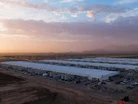
Microsoft's data centre estate is undoubtedly becoming one of the largest physical technology footprints in the US.
The hyperscaler is expanding both the number of facilities it operates and the scale of individual campuses, with projects measured in gigawatts, millions of square feet and thousands of acres.
Globally, Microsoft says its cloud infrastructure now spans more than 500 data centres across more than 80 Azure regions in 34 countries.
That network is supported by more than 800,000km of fibre, more than 190 network points of presence and over 40GW of contracted renewable energy across 26 countries.
Although Microsoft operates data centres around the world, the US serves as the focal point for many of its largest AI infrastructure projects.
Measuring Microsoft's US data centre footprint
According to Data Center Map, Microsoft has 260 data centres across the US that are operational, under construction or planned, highlighting the sheer scale of the company's digital infrastructure pipeline.
Microsoft's US data centre estate is growing in both size and capacity, with each new facility adding to the company's expanding AI infrastructure.
One example is Fairwater, one of Microsoft's US AI data centres in Wisconsin, introduced in September 2025.
The campus covers 315 acres and includes three buildings with a combined 1.2 million square feet under roof, making it one of the company's most ambitious AI facilities to date.
Scott Guthrie, Executive Vice President of Cloud & AI at Microsoft, described the project as the "largest and most sophisticated AI factory we've built yet".
Unlike conventional cloud data centres, which typically support many separate applications such as websites, email and business software, Fairwater is designed to function as a single AI supercomputer.
Hundreds of thousands of NVIDIA GPUs are connected through a flat networking architecture, enabling AI training and inference workloads at exceptional scale.
Microsoft says the facility delivers 10 times the performance of today's fastest supercomputer.
The campus runs one interconnected cluster of NVIDIA GB200 servers alongside millions of compute cores and exabytes of storage. Azure has also become the first cloud provider to deploy NVIDIA GB200 server, rack and full data centre clusters.
Alongside computing performance, Microsoft is also adapting how these facilities are cooled.
"We're also using liquid cooling to support AI workloads in many of our existing data centres. This liquid cooling is accomplished with Heat Exchanger Units (HXUs) that also operate with zero-operational water use," Scott said.
What are Microsoft's latest US data centre announcements?
Microsoft's latest US announcement centres on Pecos in West Texas, where the company plans to build a new data centre campus adding approximately 2GW of capacity.
Microsoft describes the development as one of the largest capacity additions in its history.
The project includes dedicated power generation through a separate agreement announced by Chevron.
Its subsidiary, Energy Forge One LLC, signed a 20-year agreement with Microsoft to develop a co-located power facility supplying electricity directly to the campus.
Noelle Walsh, President of Microsoft Cloud Operations and Innovation at Microsoft, said: "This multi-billion-dollar data centre campus investment over the next five to seven years reflects both the immediate needs we are seeing today and the future trajectory of AI and advanced compute, where reliable infrastructure at scale is essential to unlocking the next generation of innovation."
The company is also continuing to expand its long-standing presence in Wyoming.
In April 2026, Microsoft announced its intention to purchase approximately 3,200 acres of land for further development in Cheyenne, building on the data centre operations it first established there in 2012.
The expansion includes around 200 acres within Bison Business Park and another 3,000-acre parcel nearby.
Microsoft has so far committed more than US$68m in completed and future off-site infrastructure improvements across Cheyenne.
Bowen Wallace, Corporate Vice President, Datacenters-Americas Region at Microsoft, said: "Since the development of our first data centre in 2012, Microsoft has been working to strengthen, not strain, the community of Cheyenne.
"We're excited to continue our growth in the state bringing more investment, opportunity and tax revenue to the community we've been a part of for more than 14 years."
Building larger campuses while reducing water use
As Microsoft increases the size of its AI infrastructure, the company is placing greater emphasis on water stewardship across its operations.
Alongside improving efficiency, Microsoft says it prioritises recycled, reused and non-potable water wherever possible.
In Quincy, Washington, recycled, reused or non-potable sources account for 74% of water use.
That figure reached 99% in Singapore and 79% in San Antonio, Texas, reducing demand on freshwater supplies in some of its most water-intensive regions.
These efforts support Microsoft's wider commitment to become water positive by 2030, with the company aiming to replenish more water than it withdraws while following its Community-First AI Infrastructure approach.

During FY25, Microsoft says it reached an important milestone by replenishing more water than it withdrew across its global operations for the year.
For a company already operating one of the world's largest cloud estates, the next phase of growth is defined by increasing scale.
Microsoft's expanding US data centre footprint shows how infrastructure is becoming just as important as software in supporting the next generation of cloud and AI services.
Company portals

Executives

Noelle Walsh
President, Microsoft Cloud Operations + Innovation
Scott Guthrie
Executive Vice President, Cloud + AI Group