
Will RealSense–Nvidia Deal Reshape Robotics in Data Centres?
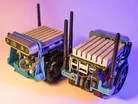
RealSense has confirmed a strategic partnership with Nvidia that brings together the firms' depth sensing and AI computing technologies. The collaboration focuses on accelerating the development and deployment of physical AI systems – with humanoid robots and autonomous mobile robots (AMRs) at the centre.
For data centres, which are increasingly supporting physical robotics through AI model training, simulation and edge inferencing, this marks a technical alignment that could shorten development cycles and improve system performance.
At the heart of this announcement is the integration of RealSense’s AI-enabled depth cameras with Nvidia’s Jetson Thor series and Isaac Sim robotics simulation system.
“This initiative cements RealSense's role as the perception platform of choice for AMRs and humanoids,” says Nadav Orbach, CEO of RealSense.
Integrated stack for robotics deployment
A key part of the collaboration is the RealSense D555 depth camera, a new sensor unit designed for robotics environments. It features the company’s v5 Vision Processor and supports Power over Ethernet (PoE), allowing for cleaner deployment with reduced cabling and processing overhead.
The D555 also supports native streaming through Nvidia’s Holoscan Sensor Bridge – a tool that enables ultra-low-latency sensor data processing, which is especially important for real-time decision-making in robotics.
Additional features include a ruggedised housing, a global shutter for fast image capture, inertial measurement unit and native ROS 2 (Robot Operating System) support. On-camera neural networks allow for image analysis to be handled at the edge – reducing reliance on external processing and minimising latency.

The integration with Nvidia’s Jetson Thor platform brings in the power of the Blackwell GPU architecture. Jetson Thor delivers up to 2,070 FP4 teraflops of AI compute within a 130-watt power envelope – offering 7.5 times the AI compute and 3.5 times the energy efficiency of the previous-generation Jetson Orin module.
System architectures have been specifically validated and optimised for Jetson Thor, allowing for more consistent performance and better energy management across demanding robotics applications.
“By providing native integration and performance optimisations with Nvidia Thor and Holoscan Sensor Bridge, we are accelerating the mainstream adoption of physical AI,” says Nadav.
Simulation, optimisation and performance gains
The collaboration enables developers to stream image and depth data directly into Nvidia’s Isaac Sim simulation environment. Isaac Sim is a robotics development platform that allows for high-fidelity, GPU-accelerated simulation to test algorithms before they are deployed in the real world.
This direct integration is expected to reduce the time from prototype to deployment, giving engineers a more streamlined development path.
Real-time sensor fusion – which brings together multiple data types for more accurate decision-making – is supported by Holoscan Sensor Bridge and RealSense's perception stack. This helps to improve robot autonomy by enabling better scene understanding and interaction with dynamic environments.
As the robotics sector matures, platform consistency and hardware–software co-design are becoming critical. The RealSense–Nvidia alignment is consistent with broader moves towards standardised development frameworks and modular robotics platforms.
“Together, we are enabling the robotics industry to unlock the extraordinary potential of physical AI and drive the future of intelligent machines,” explains Nadav.
A growing role for robotics in data-centric operations
The growth in AI-powered robotics is particularly relevant to data centres, both as enablers and end users. With generative AI models requiring real-world interactivity and robotics applications being trained in simulation environments hosted in data centres, the demand for integrated hardware stacks is rising.
Humanoid robotics and AMRs are already showing traction in logistics, warehouse automation and industrial settings. With improved sensor accuracy, reduced latency and greater power efficiency, these systems are becoming more viable for long-term deployment.
The performance gains delivered by Jetson Thor, combined with RealSense's depth sensing, are designed to address three of the key technical challenges in robotics: perception, processing speed and energy usage.
The impact is expected to stretch across industrial automation, healthcare, access control and consumer robotics. While initial adoption will depend on developer support and clear use cases, the focus on seamless integration suggests both companies are addressing long-standing obstacles that have slowed broader uptake.
RealSense and Nvidia are positioning themselves to take advantage of the growing demand for intelligent machines – both in how they operate and how they are built.
