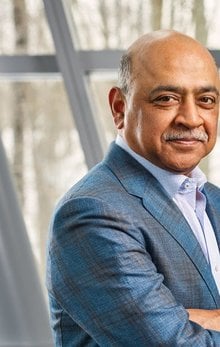
IBM CEO Questions ROI on Massive AI Data Centre Spending

IBM CEO Arvind Krishna has raised concerns over the financial viability of the global AI buildout, arguing that the scale of investment required for next generation data centres far exceeds any realistic return.
Speaking on the “Decoder” podcast with host Nilay Patel, he outlined calculations that place worldwide AI computing commitments at around 100GW of capacity and a cost of roughly US$8tn.

“There’s no way you’re going to get a return on that in my view because eight trillion of capex means you need roughly 800 billion of profit just to pay for the interest,” said Arvind Krishna.
He explained that he bases his model on today’s data centre economics, noting that “anything in the future is speculative”.
Calculating the cost of extreme scale
Arvind described a rough metric that places the cost of filling a 1GW data centre at around US$80bn.
“So if you’re going to commit 20 to 30 gigawatts, that’s one company, that’s a 1.5 trillion of capex,” he said. He pointed to current industry announcements in pursuit of Artificial General Intelligence (AGI), which he believes collectively signal about 100 gigawatts of commitments worldwide.
A large portion of that cost comes from the rapid depreciation cycle of AI chips. “You’ve got to use it all in five years because at that point, you’ve got to throw it away and refill it,” he said.
High-density GPU systems and advanced cooling architectures underpin these facilities, driving both capex and renewal costs higher than in traditional cloud builds.
Nilay Patel asked whether he had shared these concerns with Sam Altman, CEO of OpenAI. Arvind replied: “It’s a belief that one company is going to be the only company that gets the entire market. That’s a belief. That’s what some people like to chase. And I understand it from their perspective. That’s different than I agree with.”
Scepticism on AGI and its infrastructure demands
Arvind also questioned whether current architectures will lead to AGI at all. While some technologists believe AGI would justify unprecedented data centre construction, he suggested the field may face limits without a new breakthrough.
“I’m not convinced that the current set of known technologies gets us to AGI,” he said, estimating the chance of achieving it at “about 0–1%” unless future models combine multiple types of knowledge more effectively.
Despite this, he said the enterprise benefits of AI are already clear: “I think it’s going to unlock trillions of dollars of productivity in the enterprise, just to be absolutely clear.”
Space-based data centre concepts enter the conversation
While Arvind questioned the scale of terrestrial data centre investment, Google CEO Sundar Pichai recently discussed a very different kind of infrastructure expansion.
Speaking on the “Google AI: Release Notes” podcast, Sundar described early work on Project Suncatcher, which he called “a moonshot exploring a new frontier: equipping solar-powered satellite constellations with TPUs and free-space optical links to one day scale machine learning compute in space”.
He acknowledged the idea “seems crazy”, but added that “when you truly step back and envision the amount of compute we’re going to need, it starts making sense and it’s a matter of time”.
Google research released in November suggests that falling launch costs could make the operational price of a space-based data centre comparable to an earthbound facility by the mid-2030s.
Meta increases data centre investment
Back on the ground, Meta continues to scale out in support of its AI roadmap.
In its Q3 2025 earnings call, CEO Mark Zuckerberg confirmed that the firm has raised its full-year capital expenditure guidance to US$70–72bn, with 2026 spending set to be “notably larger”. The majority of that increase is aimed at expanding Meta’s data centre footprint and GPU capacity.
Arvind’s comments highlight the tension between escalating infrastructure requirements and the uncertain returns attached to the current AI race.
As hyperscalers pursue increasingly large compute builds, the financial, physical and technical limits of data centre expansion are becoming central to the industry’s wider debate.