Infineon: The World’s Largest Chip Fab in Dresden, Germany
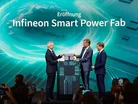
Infineon Technologies has officially opened its new Smart Power Fab in Dresden, Germany, marking the company's largest-ever investment and boosting production of chips that help power AI data centres.
Backed by a €5bn (US$5.69bn) investment, the facility doubles manufacturing capacity at Infineon's Dresden campus, reinforcing the city's status as Europe's leading semiconductor hub.
Known as Silicon Saxony, Dresden is already home to one of the continent's largest concentrations of chip manufacturing and is key to Europe's plans to strengthen domestic semiconductor production.
The project creates 1,000 direct jobs and establishes what Infineon describes as the world's largest factory dedicated to intelligent power semiconductors and analogue and mixed-signal technologies.
Jochen Hanebeck, CEO of Infineon, says: "We're opening our new plant at just the right time.
"Our Smart Power Fab is creating urgently needed capacities for the key technologies of the future, for everything from energy supply for AI data centres to software-defined vehicles and renewable energies.
"Infineon is thus giving an important impulse in making the global AI revolution possible and securing supply chains in critical industries.
"By taking this step, we are strengthening our global vanguard position as a leading manufacturer of power semiconductors and analog / mixed-signal technologies.
The investment comes as demand for AI infrastructure heightens, increasing the need for efficient power management technologies that support energy-intensive computing environments.

Supporting AI infrastructure
Infineon says chips produced at the Smart Power Fab will help improve power delivery for AI data centres by combining power semiconductors with analogue and mixed-signal components.
These technologies are designed to increase efficiency while supporting the high electrical demands created by AI workloads.
The same technologies are also used across renewable energy systems, industrial applications and software-defined vehicles.
- Dresden is a critical location to Europe’s plans for a stable semiconductor supply chain.
- Last month, GlobalFoundries and Qualinx announced the successful completion of an end-to-end semiconductor manufacturing flow at GlobalFoundries’ fab there.
Europe's semiconductor strategy
The opening reflects Europe's wider effort to reduce reliance on overseas chip manufacturing.
According to the European Commission, the global semiconductor market reached US$796bn in 2025, driven by demand for AI systems, data centres and advanced logic and memory chips.
The European Chips Act has become the centrepiece of that strategy.
Infineon is thus giving an important impulse in making the global AI revolution possible and securing supply chains in critical industries
Industry body SEMI estimates the legislation has helped catalyse €69bn (US$80bn) in public and private semiconductor investment across Europe.
Bloomberg has reported that Infineon's Dresden expansion received around €1bn (US$1.145bn) in subsidies through the programme.
Dr Karsten Wildberger, German Federal Minister for Digital Transformation and Government Modernisation, says: "What is being produced here in Dresden secures jobs and creates value in Germany, because these cutting-edge chips are at the heart of key technologies such as electric vehicles, wind turbines and the power infrastructure for AI data centres.
“The Smart Power Fab marks another milestone on Germany's path toward digital sovereignty and demonstrates that Germany can move fast, Germany can deliver high-tech innovation and Germany can shape the future."
As operators continue expanding AI data centre capacity across Europe, facilities such as Infineon's Smart Power Fab are becoming a significant part of the infrastructure supply chain, providing the power management technologies needed to support the next generation of computing.