Explore Microsoft's World-First AI Superfactory Data Centre
The race to train AI models is pushing data centre infrastructure to its limits.
Factors like the speed of light and heat dissipation now dictate how processors are packed and powered, influencing how and where AI infrastructure is built.
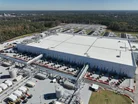
Microsoft has opened its second Fairwater AI data centre in Atlanta, Georgia, connecting to the existing Wisconsin site via a dedicated AI wide area network.
The facility is designed to house hundreds of thousands of Nvidia GB200 and GB300 graphics processing units (GPUs) in a single flat network architecture.
This approach abandons the traditional cloud data centre model for one purpose-built for modern AI training.
Satya Nadella, CEO at Microsoft, says: “Today we announced our new Fairwater data centre in Atlanta, connected with our first Fairwater site in Wisconsin and our broader Azure footprint to create the world’s first AI superfactory.”
Purpose-built design for AI workloads
The Atlanta site shows how AI workloads have evolved, requiring a fundamental change in data centre design and cooling.
Satya says: “AI workloads have evolved beyond large-scale pre-training. Today, they include fine-tuning, reinforcement learning, synthetic data generation, evaluation pipelines and more.”
To manage the intense heat, Fairwater data centres use facility-wide liquid cooling. Each rack draws approximately 140kW of power, with rows consuming 1,360kW.
The closed-loop system reuses water after an initial fill, equivalent to the annual consumption of 20 homes.
Because air cooling cannot remove heat fast enough at these power levels, the move to liquid cooling is essential for packing computing power more densely.
Two-storey architecture and GPU density
Microsoft uses a two-storey building design to minimise cable run lengths between GPUs, which is critical for performance in large-scale AI clusters.
Satya explains: “Fairwater’s two-storey design and liquid cooling system lets us place racks in three dimensions and pack them with GPUs as densely as possible, minimising cable runs and improving latency and effective bandwidth.”
Each rack houses up to 72 Nvidia Blackwell GPUs connected via NVLink, Nvidia’s proprietary interconnect technology.
The Blackwell accelerators also support FP4, a four-bit floating point format that boosts operations per second while cutting memory needs. Each rack provides 1.8TB of GPU-to-GPU bandwidth.
Grid power, stability and network connectivity
Atlanta is chosen for its access to highly reliable utility power (99.99% uptime) at a lower cost. This allows Microsoft to forgo traditional backup infrastructure like on-site generators for the GPU fleet.
However, managing power at this scale creates challenges, as large training jobs can cause power oscillations affecting grid stability.
Microsoft has developed software and hardware solutions with partners to smooth demand and enforce power thresholds.
To connect its facilities, Microsoft has deployed more than 193,000km (120,000-mile) of new fibre for a dedicated AI wide area network (WAN).

Satya says: “Every Fairwater DC will connect through our continent-spanning AI WAN to prior generations of AI supercomputers, forming a truly fungible pool of compute.”
Microsoft is bringing more than 100,000 GB300 GPUs online this quarter for inference.
Satya concludes: “For us, it’s all about turning every gigawatt into the maximum number of useful tokens. Not every GW is created equal.”


Executives
Satya Nadella
Chairman and CEO