NTT’s Digital Journey to Net Zero by 2040

NTT has committed to achieving net zero emissions by 2040 through a combination of photonic technology deployment and renewable energy investments.
The Japanese telecommunications company plans to reduce greenhouse gas emissions by 80% by 2030 as part of its decarbonisation strategy. As part of these efforts, the company has acquired Japan’s second largest wind generating company and is establishing a subsidiary to develop and manage renewable energy grids for its own power consumption.
These moves support NTT’s broader sustainability framework built around three pillars: protecting nature, maximising wellbeing and improving prosperity.
“We aim to resolve a variety of social issues, contributing to a world where Earth and humanity can sustainably coexist,” says Akira Shimada, CEO of NTT.
“Striving for a resource-recycling future, not a resource-consuming one.”
IOWN photonic technology reduces power consumption
Central to NTT’s emission reduction strategy is the deployment of its Innovative Optical and Wireless Network (IOWN) technology, which the company has been developing since 2019.
IOWN replaces electronic connections with photonic connections, delivering improved responsiveness whilst consuming lower levels of power. IT also enables all-photonics networks with end-to-end solutions connecting devices at network edges.
Digital twin technology is also incorporated to build interactive copies of complex systems including cities, traffic networks, machines and human bodies. This technology enables precise testing and experimentation for decision-making processes.
NTT launched IOWN 1.0 commercial services in 2023, marking the first version of the technology available to enterprise customers. The company positions IOWN as infrastructure for the next generation of internet services, making technology connections invisible whilst maintaining high levels of connectivity and responsiveness.
“Following this, research, development and commercialisation activities progressed steadily and in 2023, NTT launched IOWN 1.0 as the first version of IOWN commercial services,” says Shingo Kinoshita, Senior Vice President and Head of R&D Planning Department at NTT Corporation.
Placing decarbonisation at the centre
Beyond network infrastructure, NTT is developing technology solutions for circular economy applications. The company has created systems that convert food waste into fertiliser through fermentation processes installed at supermarket locations.
Vegetable scraps and other food waste undergo breakdown processes before being supplied to farms as compost.
The company is also developing sustainable land-based aquaculture farms that enable ethical production and scaling of microalgae and seafood. These systems operate in landlocked areas, providing ongoing food sources without proximity to marine environments.
NTT’s sustainability approach addresses climate targets set by the Paris Agreement, which aims to limit global warming to 1.5°C by 2030.
The Renewable Energy Institute reports that failure to meet these targets could result in more erratic weather conditions with wide-reaching impacts. Likewise, the UN estimates that missing 2040 targets could lead to one in four children living in areas experiencing extreme water shortages.
Considering the broader social impact of digital operations
The company’s IOWN technology roadmap includes applications for autonomous vehicle systems and smart city infrastructure.
NTT claims the technology will enable real-time crowd monitoring with automatic emergency service alerts, whilst supporting autonomous vehicles that reduce road congestion and traffic accidents.
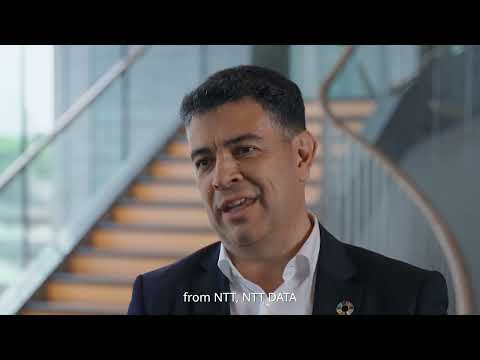
Future IOWN implementations will focus on photonics-electronics convergence devices applied to communications and computing environments. The company plans to deploy these technologies in Digital Twin Computing (DTC) and next-generation AI applications.
“To meet the expectations of our many stakeholders, our mission is to continue to contribute to the realisation of a better society by placing sustainability at the core of our management,” says Akira.
“We will continue to take on the challenge of making the NTT Group an organisation that supports global sustainability through the creation of new value.”
The company’s commitment to sustainability extends beyond emission reductions to encompass broader environmental and social impacts. Its strategy involves cultivating green society initiatives whilst prioritising decarbonisation strategies to minimise human impact on natural systems.
“Going forward, NTT plans to implement the IOWN vision in the world by commercialising photonics-electronics convergence devices, applying them to communications and computer environments,” Shingo adds. “Making full use of them in such fields as Digital Twin Computing (DTC) and next-generation general-purpose AI.”