Trane and NVIDIA: Tackling Rising Heat in AI Data Centres

Trane Technologies is introducing upgrades to its cooling systems for AI data centres alongside new and revised reference designs within its Trane Continuum Rubin DSX portfolio.
The company is also developing simulation technology to visualise complex 3D data centre scenes before real-world deployment.
Enhancements have been made to Trane's thermal management reference design for gigawatt-scale AI facilities, developed in integration with NVIDIA’s Omniverse DSX Blueprint.
The updated design delivers close to a 10% gain in overall thermal management performance compared with the original 1-gigawatt model.
This improvement frees up 22 megawatts of cooling capacity, which operators can redirect towards IT workloads. The result is higher compute output without an increase in total energy consumption, usually a key concern in high-density AI environments.
“Since the launch of our industry-first thermal management system reference design, our team has continued to work hand-in-hand with NVIDIA to push the boundaries of efficiency, scalability and intelligent simulation for gigawatt-scale AI infrastructure,” says Mauro Atalla, Senior Vice President, Chief Technology and Sustainability Officer at Trane Technologies.
“These latest advancements represent a major step forward in helping enable the world’s most demanding AI and high-performance computing environments to scale sustainably, reliably and with accelerated digital insight.”
Cooling efficiency for AI workloads
Trane Technologies positions its updated system as a way to address the heat load in high-performance computing environments, through improved cooling distribution and system optimisation.
The design supports a shift in resource use within the facility by refining how cooling capacity is allocated. Instead of expanding total energy input, operators have the option to channel reclaimed cooling capacity into IT power. This aligns with the need to maintain efficiency while meeting rising compute demand.
The integration with NVIDIA Omniverse DSX Blueprint introduces simulation capabilities into the design process.
This platform allows the creation of digital twins, which enable operators to model cooling performance and test infrastructure configurations before real-world deployment.
Vladimir Troy, Vice President of AI Infrastructure at NVIDIA, says: “Efficiently scaling gigawatt-scale AI factories requires a fundamental shift in how we approach thermal management and data centre infrastructure simulation.
“Trane Technologies’ integration with the NVIDIA Omniverse DSX blueprint enables the creation of high-fidelity digital twins that help operators optimise cooling performance and maximise energy efficiency for the next generation of AI workloads.”
New reference designs for large-scale deployment
Alongside the updated system, Trane Technologies is expanding its Trane Continuum Rubin DSX portfolio with two new reference designs aimed at large-scale AI deployments.
The first is a readily available 250-megawatt duplex simplified system design. It uses free cooling and achieves a 14% increase in thermal management system efficiency, with 10% of the heat rejection load redirected to heat recovery.
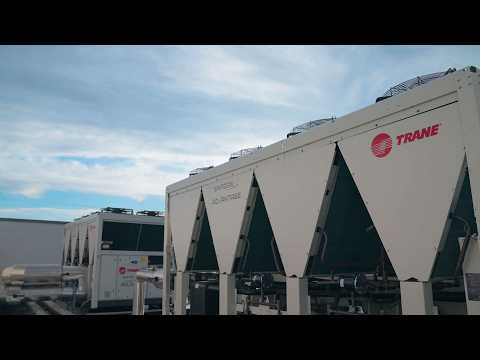
The second design focuses on a 1-gigawatt AI factory architecture using magnetic-bearing air-cooled chillers. This approach uses 3-megawatt units to reduce the number of components required across the cooling system. It also removes the need for water use to assist in cooling efficiency.
Magnetic-bearing chillers operate without oil, which lowers maintenance requirements and supports consistent performance. The system aims to deliver quieter operation and improved efficiency through Trane’s chiller plant controls, which manage how cooling resources are distributed across the facility.

Digital tools and simulation environments
Beyond physical infrastructure, Trane Technologies is developing its digital capabilities to align with the Omniverse DSX framework.
The company has introduced OpenUSD-based SimReady assets, which are digital components designed for simulation environments.
OpenUSD (Universal Scene Description) enables the creation of complex 3D scenes and data. In data centre design, it supports interoperability between tools and systems.
SimReady assets are structured to function within simulation workflows and allow engineers to model performance and adjust configurations with precision.
These assets include structured metadata, meaning data that describes other data. The metadata provides detailed information about system components, enabling more accurate modelling and easier configuration.
This supports scalability as operators expand data centre capacity or adapt designs for different environments. Trane Technologies is placing emphasis on planning and optimisation before deployment by developing simulation technology.
The company's approach reflects a broader move within the data centre sector towards digital modelling, where operators test and refine infrastructure in virtual environments to reduce risk and improve their performance outcomes.
Company portals


Executives

Mauro J. Atalla
SVP, Chief Technology & Sustainability Officer
Vladimir Troy
VP / EStaff, AI Infrastructure