Will Huawei’s Xinghe Network Boost Europe’s Data Centres?
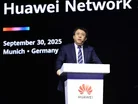
Huawei brings its Huawei Network Summit 2025 to Munich, where more than 800 experts and partners from 30 countries discuss intelligent network trends and Europe’s digital transformation.
The company uses the event to launch its fully upgraded Xinghe Intelligent Network for campus, wide area and data centre environments, designed to improve network innovation and productivity.

Jim Lu, Senior Vice President and President of the European Region at Huawei, tells the summit: "As AI capabilities advance and costs fall, its large-scale adoption is accelerating. Huawei's fully upgraded Xinghe Intelligent Network streamlines data flow and delivers a premium AI application experience, making it ideal for accelerating intelligent transformation of industries.
“Looking ahead, Huawei remains committed to working with customers and partners to build a solid foundation for intelligence and achieve shared success in a smarter future."
Defining the '3-Beyond' framework
Steven Zhao, Vice President of Huawei’s Data Communication Product Line, explains the foundation of the network.
"Huawei's Xinghe Intelligent Network is built on a '3-Beyond' innovation framework," says Steven. "'Beyond Performance' pushes the boundaries of network capabilities to deliver an exceptional service experience. 'Beyond Resilience' enables unprecedented resilience to build ultimate reliability and full-scope security. 'Beyond Autonomy' integrates digital and physical worlds to embrace high-level autonomous networks."
The upgraded offerings cover multiple scenarios. For campuses, Xinghe introduces Wi-Fi Shield alongside new innovations.
The industry’s first spycam-detecting access point (AP) uses full-band scanning and intelligent algorithms to spot hidden cameras. Wi-Fi sensing with patented algorithms tracks centimetre-level micro-motions to prevent intrusions and protect sensitive areas.
Data centre focus: AI Fabric 2.0
For data centres, Huawei presents Xinghe AI Fabric 2.0, built for resilience and efficiency. Traditional processes for banking services can take days, with manual security updates proving slow and error-prone. With transaction volumes reaching 100,000 per second, fault recovery becomes critical.
Xinghe AI Fabric 2.0 simulates and configures thousands of network and security devices in just five minutes, which Huawei describes as a 100-fold efficiency gain. The Eagle-Eye Engine tracks 200,000 flows in real time, delivering full traffic quality analysis, fault detection in seconds and recovery within minutes.
Huawei also co-releases with OEHI the Benchmarking Ethernet Interconnect for AI/HPC Workloads and Network Design Recommendations White Paper. Findings show Ethernet outperforming InfiniBand on key measures, with Non-Stop Load Balancing (NSLB) algorithms enhancing RDMA over Converged Ethernet (RoCE) performance. Huawei positions Ethernet as the main choice for intelligent computing data centres.
Expanding WAN and automation capabilities
In wide area networks (WAN), Huawei’s Intelligent WAN improves service delivery. Internet service providers struggle to identify encrypted applications, which limits value-added services. Huawei’s precise service awareness algorithm raises identification accuracy for encrypted traffic to more than 95%.
In the power sector, flexible grid rollouts place strict demands on latency. Huawei applies intelligent jitter elimination technology that holds asymmetrical latency variation within 10 microseconds – 20 times better than the industry standard.
Creating intelligent networks with top-tier autonomy
Huawei also introduces NetMaster, a network intelligent agent that automates awareness, analysis, decision-making and execution. In higher education and office use cases, NetMaster automatically resolves 80% of wireless issues, reducing resolution time from hours to minutes.

Healthcare benefits from new roaming and switching technology. Advanced Same Frequency Network (ASFN) zero-roaming technology enables nanosecond synchronisation between APs to keep services always on. Twin-engine switches with dual-microcontroller units and dual-data-channel architecture enable sub-second failover, supporting medical terminals where reliability is critical.
In the SME market, it offers HUAWEI eKit to manage budget limits and skill shortages. The AR180 enterprise-class wireless router integrates routing, switching, Wi-Fi 7 and VPN in one device, cutting capital expenditure by 50%. The Wi-Fi 7 AP673 access point supports three times the average concurrent capacity, enabling up to 120-channel HD video conferencing.
Huawei also releases the Wi-Fi 7 Advanced Technology White Paper with partners and standards bodies, outlining features such as 80 MHz continuous multi-AP networking, integrated Wi-Fi communication and sensing and full-scope security.
Huawei closes the summit by setting out its strategy to maintain Xinghe Intelligent Network as a foundation for future infrastructure. The company states it will continue innovation and ecosystem collaboration across Europe’s data centres, campuses and WAN environments.