Davos: Why Musk Links AI Growth to Data Centre Power
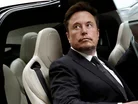
Elon Musk’s surprise appearance at the World Economic Forum WEF) in Davos offered a wide-ranging view of how autonomous vehicles, AI and robotics could reshape global infrastructure.
For the data centre sector, his remarks repeatedly returned to a core constraint – the need for vast, reliable and affordable energy to support accelerating compute demand.
Interviewed by BlackRock CEO Larry Fink, Elon framed his ambitions across Tesla and other ventures as part of a broader objective to “maximise the probability that civilisation has a great future”.

That future, he argued, will be defined by AI systems that require unprecedented levels of processing power, storage and connectivity.
Autonomous systems and compute demand
A central theme of the discussion was self-driving technology and Tesla’s push towards large-scale deployment.
Despite recent scrutiny of Tesla’s Cybercab trials in the US, Elon said that autonomy is close to maturity.
“Self-driving cars is essentially a solved problem at this point,” he said, adding that Tesla expects “very widespread” robotaxi deployment across the US by the end of the year.
He also said the company is seeking approval for “supervised full self-driving” in Europe, noting, “we hope to get… approval in Europe, hopefully next month”, with China following a similar timeline.
Behind these ambitions sits a growing reliance on AI models trained and refined in data centres.
Real-time perception, mapping and decision-making systems depend on centralised training environments supported by hyperscale infrastructure, before being deployed at the edge in vehicles.
AI acceleration and infrastructure pressure
Elon’s predictions for AI were stark. “I think we might have AI that is smarter than any human by the end of this year,” he said, adding that it would happen “no later than next year”.
He went further, suggesting that by “2030 or 2031, call it five years from now, AI will be smarter than all of humanity collectively”.
Such timelines imply rapid expansion of compute capacity.
Training frontier models already requires dense clusters of accelerators, high-speed networking and resilient power delivery.
As models scale, data centres face mounting pressure around energy availability, cooling and grid connection timelines.
Elon described the pace of AI development as something that would eventually “saturate human needs” and unlock global economic growth.
For operators, this growth translates into sustained demand for high-density facilities built close to power and network infrastructure.
Power constraints and solar economics
Energy supply emerged as a recurring constraint.
Elon argued that the US has ample solar potential to meet national electricity demand.
“You could take a small corner of Utah, Nevada or New Mexico… to generate all of the electricity that the US uses,” he said.
However, he warned that policy is distorting deployment economics.
“Unfortunately, the tariff barriers for solar are extremely high and that makes the economics of deploying solar artificially high.”
According to Elon, these barriers slow the rollout of clean energy needed to support energy-intensive data centres being built for AI.
He stressed that securing sufficient power is “critical” as AI workloads drive rapid growth in electricity consumption.
For data centre developers, this highlights the growing link between energy policy, renewable deployment and the pace at which new capacity can be delivered.
Robots, factories and digital backbones
Beyond vehicles and AI models, Elon pointed to robotics as a major future driver of compute demand.
He predicted that “there will be more robots than people” and described AI and robotics as “the path to abundance for all”.
Tesla’s Optimus humanoid robot is central to that vision.
Elon said Optimus is already performing “simple tasks in the factory” and expects it to handle more complex work soon.
“By the end of this year, I think they will be doing more complex tasks, and probably by the end of next year, I think we’d be selling humanoid robots to the public,” he said.
Each of these systems relies on a digital backbone of training environments, simulation platforms and operational data flows that are anchored in data centres.
As robots become more autonomous, the demand for continuous model updates and analytics further tightens the link between physical automation and centralised infrastructure.
Safety, regulation and scale

Elon also acknowledged the risks of advanced robotics, warning: “We need to be very careful with robotics. We don’t want to find ourselves in a James Cameron movie. Love his movies, but we don’t want to be in Terminator, obviously.”
Safety, regulation and trust will shape how quickly AI-driven systems are adopted.
For the data centre sector, this means operating environments that can support compliance, transparency and secure processing at scale.
While Elon closed with remarks on longevity and space travel, his Davos appearance underscored a near-term reality.
Ambitions for autonomy, AI and robotics are accelerating demand for resilient, power-rich data centre infrastructure, with energy availability emerging as the limiting factor shaping how fast that future can arrive.




Executives

Elon Musk
Tesla CEO
Larry Fink
Chairman and Chief Executive Officer