
Ecolab Warns AI Data Centres Face Rising Water Challenge
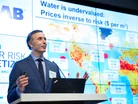
A growing gap between public perception and operational reality is putting pressure on data centre operators as the water demands of artificial intelligence (AI) rise sharply.
According to Ecolab’s third annual Watermark Study, most global consumers underestimate the amount of water AI systems require, especially in data centres where water-cooled infrastructure dominates.
While energy consumption linked to AI is well recognised, the study finds far less awareness of its impact on water use.
Just 41% of US consumers, for example, say they know AI systems use water. By contrast, 55% are aware of AI’s power demands. The gap is wider still in Asia Pacific and Latin America.
Ecolab, which provides water and hygiene solutions to industrial clients including data centre operators, uses this study to highlight the increasing strain AI places on freshwater systems.
Christophe Beck, Chairman and CEO of Ecolab, says: “By 2050, the world will have nearly 30% more people and require 47% more energy. Water demand will continue to surge – yet by 2030, the world already faces a projected 56% water deficit.
“Energy can be generated, but water cannot be created.”
Water reuse remains low in the AI sector
At the centre of the issue is the relatively low rate of wastewater reuse in AI-related operations.
Just 20% of industrial wastewater is currently recycled for cooling systems in data centres. That means most water drawn into facilities is fresh and potentially drinkable.
Christophe frames this as both a technical flaw and a commercial opportunity.
“We see wastewater as an engineering flaw and a missed opportunity as a driver for business growth,” he says.
Ecolab argues that through advanced analytics, real-time temperature controls and predictive maintenance, data centres could move towards water profiles “that use less water than a car wash”.

While the expansion of AI workloads is accelerating data centre buildouts, climate conditions are tightening water supply in key regions.
As hyperscale operators scale capacity to support machine learning and large language models, cooling becomes one of the largest non-compute resource burdens.
Ecolab’s own work in the data centre sector involves developing smart water solutions designed to increase reuse rates, monitor usage in real time and reduce dependence on potable water.
These services are increasingly marketed as part of sustainability strategies for colocation providers and hyperscale clients.
Despite the pressure, the report finds that consumers are still optimistic about AI’s long-term benefits.
However, that optimism depends on corporate transparency and action.
While the expansion of AI workloads is accelerating data centre buildouts, climate conditions are tightening water supply in key regions.
As hyperscale operators scale capacity to support machine learning and large language models, cooling becomes one of the largest non-compute resource burdens.
Ecolab’s own work in the data centre sector involves developing smart water solutions designed to increase reuse rates, monitor usage in real time and reduce dependence on potable water.
These services are increasingly marketed as part of sustainability strategies for colocation providers and hyperscale clients.
Despite the pressure, the report finds that consumers are still optimistic about AI’s long-term benefits.
However, that optimism depends on corporate transparency and action.
Trust in corporate water management continues to decline
The study also finds a clear trust gap when it comes to how companies manage water.
Fewer than half of respondents believe businesses are implementing adequate reuse or recycling practices, including 43% in the US, 44% in Europe and 48% in both Asia Pacific and Latin America.
Governments fare even worse, with just 42% of US respondents confident in state-led water stewardship.
Yet, a majority, 67%, believe both governments and businesses should lead in reducing climate impacts linked to water stress.
Emilio Tenuta, Chief Sustainability Officer at Ecolab, says: “Global consumers recognise smart water management is essential for a resilient future and they expect businesses to lead with both transformative technologies and transparent action to make it a reality.”
He suggests that AI itself could play a role in optimising water use.
Ecolab points to early efforts to apply AI to localised water systems, improving efficiency while enabling data centre operators to meet regulatory and sustainability requirements.
The Watermark Study also finds consumers are more likely to support companies with strong environmental performance.
Purchasing decisions are starting to reflect this, particularly in younger demographics who associate tech innovation with sustainability leadership.
Data centres under pressure to close the awareness gap
As the number of data centres supporting AI grows, so does scrutiny of the resources they consume.
The Watermark Study places AI and data centre growth firmly on the map of emerging global water concerns, alongside well-known high-consumption sectors like agriculture.
Extreme weather events are shaping consumer attitudes, with rising concern about drought, flooding and wildfires across all surveyed regions.
Latin America shows the highest short-term concern, while overall awareness that climate change drives water stress remains high.
Interestingly, despite the rise in concern, the report notes a slight decline in public anxiety over water scarcity since earlier studies.
This shift, Ecolab suggests, may reflect growing confidence in solutions, even if the technical challenges remain unresolved.

More than 60% of respondents in all surveyed regions believe water scarcity is solvable.
Optimism is highest in Latin America (84%) and the IMEA region (83%).
Ecolab, which reports annual sales of US$16bn, continues to position itself as a critical partner for industrial clients navigating climate-linked resource challenges.
Its pitch to the data centre sector is clear: use AI to make water systems smarter, reduce dependency on freshwater and close the trust gap with the public.
With rising AI workloads and water-stressed environments colliding, data centre operators are under pressure to measure, manage and explain their water use.
The solution, Ecolab argues, lies not only in infrastructure upgrades but in shifting the perception that water is limitless.
Company portals

Executives
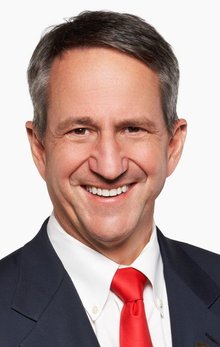
Christophe Beck
Chairman and CEO

Emilio Tenuta
Senior Vice President and Chief Sustainability Officer at Ecolab