HPE and NVIDIA: Redefining Storage Solutions at the Edge

Hewlett Packard Enterprise (HPE) has become the first vendor to achieve NVIDIA-Certified Storage validation for an object-based platform, with the HPE Alletra Storage MP X10000 earning Foundation-level certification.
The certification confirms that NVIDIA has validated and benchmarked the system's performance under loads of up to 128 GPUs, completed functional tests for enterprise-grade availability and reliability, and verified that the storage layer feeds data to accelerated computing resources efficiently enough to deliver faster model training, lower latency inference and better overall utilisation.
The announcement first came at NVIDIA GTC 2026 in San Jose, where HPE outlined a broad expansion of its NVIDIA AI Computing portfolio with particular emphasis on how storage fits into the AI data pipeline. As inference workloads grow in complexity, the speed and reliability with which storage systems deliver data to GPU clusters has emerged as a production bottleneck – one that the X10000 certification is specifically designed to address.

Antonio Neri, President and CEO of HPE, frames the broader challenge: "The AI race is fundamentally about speed, scale and trust.
“Our industry leadership across cloud, networking and AI enables organisations to operationalise AI securely, efficiently and at an unprecedented scale. Together with NVIDIA, HPE delivers turnkey AI factories and networks that transform AI ambitions into real enterprise value."
AI data pipelines demand tighter storage and compute integration
As AI infrastructure moves into production, data pipelines and inference context have become performance constraints that cannot be resolved at the compute layer alone. HPE is continuing to evolve the Alletra MP X10000 with the aim of centralising intelligent data handling and optimising how AI workloads ingest, process and deliver data across the full lifecycle – from ingest and vectorisation through to inference and recovery.
To extend this further, HPE will support the new NVIDIA STX rack-scale reference architecture to develop AI storage solutions powered by NVIDIA Vera Rubin, BlueField-4, Spectrum-X networking, Connect-X NICs and NVIDIA AI software. This positions HPE's storage roadmap in direct alignment with NVIDIA's next-generation architectural direction.
Edge deployments drive demand for scalable storage solutions
The integration of storage into edge-focused AI deployments is also advancing through HPE's expanded GPU portfolio. The company is adding the NVIDIA RTX PRO 4500 Blackwell Server Edition GPU to HPE ProLiant servers for edge deployments, small-language models, vector databases and data analytics workloads — all of which place distinct demands on adjacent storage infrastructure. HPE is also developing solutions incorporating the NVIDIA Retail Shopping Assistant Blueprint, extending edge AI capabilities into the retail sector.
Network expansion racks, meanwhile, now allow HPE Private Cloud AI deployments to scale to 128 GPUs, providing the consistent operational experience enterprises require when running larger workloads without redesigning underlying storage and data architectures.
Security and sovereignty shape the next phase of AI storage
Governance requirements are increasingly shaping how storage solutions are deployed within AI data centres. HPE has made its large Private Cloud AI system available in an air-gapped configuration, ensuring sensitive data is not exposed to external networks — a configuration targeted at sovereign and fully isolated deployments. HPE ProLiant Compute DL380a Gen12 servers are also being certified for Fortanix Confidential AI, leveraging NVIDIA Confidential Computing for secure on-premises AI model deployment and sensitive data processing.
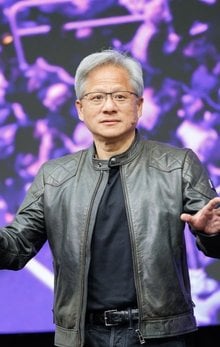
“NVIDIA and HPE are setting a new standard for enterprise AI infrastructure,” said Jensen Huang, Founder and CEO of NVIDIA. “HPE’s leadership across private cloud, networking and secure on-prem systems uniquely positions them to make AI a core enterprise capability.
“Together, we are building AI factories and AI grids – foundational infrastructure to embed intelligence into every workflow.”
Did you know?
Company portals

Executives
Antonio Neri
President & CEO
Jensen Huang
Founder and CEO