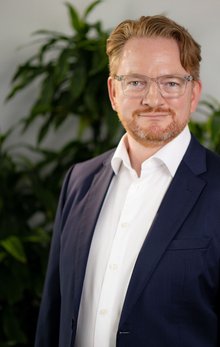
Oliver Schiebel, hscale's CEO on Building AI Data Centres
One year after launching, hscale is not talking about what it hopes to build.
The company is ahead of that conversation, focused on advancing what's already in the works.
The pan-European data centre developer has spent its first year assembling powered land, refining a hybrid data centre design and targeting Europe's fastest-growing markets beyond FLAP-D.
Speaking at Data Centre LIVE, Oliver Schiebel, CEO of hscale, explained why flexibility is becoming just as valuable as power when building for the AI era.

"What we've done differently compared to other data centre developers that have launched recently is probably we first sourced a very strong portfolio of powered land assets before we approached the market, and I think that is what separates us," Oliver said.
"It's the same gigawatt platform that we say we have that does really exist. And I think that's a huge differentiator. So we go to market with the assets ready to develop."
Designing for speed
Alongside its land strategy, hscale is investing heavily in its proprietary Magnus platform, a hybrid data centre design intended to reduce project delivery times by removing uncertainty during planning.
"It's a true hybrid design," said Oliver.
"So what it allows you to do, it allows you to permit a data centre building agnostic of whether you use it liquid cooled or air cooled, and also agnostic of which customer goes in, by multi-purpose rooms.
"And then once we know which customer wants to go in, we tailor the data centre to that customer's specific needs.
"But the improvement there is the time to market – the delivery is substantially faster if you can run the permitting process even not knowing which customer will end up in this facility.
Oliver also explained what the company's goals are for the year.
He said: "What's the big focus for us, apart from building more data centres and doing more deals with customers, is to drive that Magnus-based design even further to a higher level and to a next stage, which will then focus around high, high-density AI – really, 600kW per rack – that will turn the requirements of the traditional data centre somewhat upside down."
Looking beyond FLAP-D
Oliver said hscale sees the biggest opportunity in fast-growing tier two markets where land and power is more readily available.
The company aims to be successful in second-tier markets outside of FLAP-D constraints, with Oliver specifically mentioning Oslo, Madrid and Milan expansions.
"It's where we see good land, opportunity for powered land and where we also have the ability to really deploy at scale. And I think that is a differentiator.
"So we're obviously looking where the customer wants to go, but we're also looking where there is substantial capacity that can be delivered in a timely fashion.
"And that is how we separate. So we have strong capacity coming online in '27, in '28 and obviously beyond."

Building for hyperscalers
Magnus is also designed to help hscale balance standardisation with bespoke hyperscaler requirements by incorporating common customer specifications into a single baseline design.
"So what we do is we take the latest design standards of the most important customers, and we bake them into the base design so that our base design delivers between 70 and 80% of all the customer's base requirements.
"And that allows us to deliver a product that can be tailored quicker to the customer's specific needs than other products.
"We also source and manage the supply chain for the standard product to be able to deliver faster, which obviously is the biggest need of all customers.
"If a customer really has a very specific requirement, we're also happy to deliver that. But we have a preference, obviously, to deliver our Magnus design."
The strategy is already shaping hscale's expansion.
Oliver revealed the company has doubled down on Milan, where it now has two sites under development totalling 250MW and representing more than €2bn (US$2.28bn) of investment, while also explaining ambitions to expand into high-growth markets elsewhere.