The Role of Data Centres in NVIDIA's Skyrocketing Revenues

NVIDIA has reported full-year revenue of US$215.9bn, up 65% year on year, with its data centre division accounting for the vast majority of growth as global investment in AI infrastructure accelerates.
Quarterly revenue reached US$68.1bn, a 73% increase compared with the previous year and a 20% rise on the prior quarter. The figures underline the scale of demand for AI training and inference platforms across hyperscale and enterprise data centres.
“Computing demand is growing exponentially – the agentic AI inflection point has arrived,” says Jensen Huang, Founder and CEO of NVIDIA.
“Grace Blackwell with NVLink is the king of inference today – delivering an order-of-magnitude lower cost per token – and Vera Rubin will extend that leadership even further.
“Enterprise adoption of agents is skyrocketing. Our customers are racing to invest in AI compute – the factories powering the AI industrial revolution and their future growth.”
Data centre segment dominates
NVIDIA’s data centre business generated 91% of total sales. Fourth quarter revenue in the segment reached US$62.3bn, up 22% from the previous quarter and 75% year on year.
Growth has been supported by partnerships with AWS, Meta, Anthropic, xAI and CoreWeave, alongside collaboration with the US Department of Energy’s Genesis Mission. Major cloud providers including Amazon Web Services, Google Cloud, Microsoft Azure and Oracle Cloud Infrastructure are deploying instances based on NVIDIA’s latest architectures.

Colette Kress, Executive Vice President and Chief Financial Officer at NVIDIA, said: “We specialise in markets where our computing platforms can provide tremendous acceleration for applications.
“These platforms incorporate processors, interconnects, software, algorithms, systems and services to deliver unique value.
“Our platforms address four large markets where our expertise is critical: data centre, gaming, professional visualisation and automotive.”
The emphasis on inference efficiency is particularly relevant as enterprises shift from model training to production deployment. Lower cost per token and improved interconnect performance are central to reducing operating costs in high-density AI clusters.
Visualisation and gaming support ecosystem
Beyond data centres, NVIDIA’s professional visualisation and gaming divisions also recorded growth, reflecting demand for GPUs across creator, enterprise and consumer markets.
Professional visualisation revenue reached US$1.3bn in the fourth quarter, up 74% from the prior quarter and 159% year on year. Full-year revenue for the segment rose 70% to US$3.2bn.
Gaming revenue totalled US$3.7bn in the fourth quarter, up 47% year on year, though 13% lower than the previous quarter following seasonal demand. Full-year gaming revenue climbed 41% to US$16bn.
While smaller than the data centre division, these segments contribute to a broader ecosystem in which GPU architectures are standardised across applications. This can influence developer familiarity and enterprise adoption patterns.
Automotive AI extends platform reach
NVIDIA’s automotive business generated US$604m in fourth quarter revenue, up 6% year on year, with full year revenue rising 39% to US$2.3bn. Growth has been linked to increased adoption of the company’s self-driving platform.
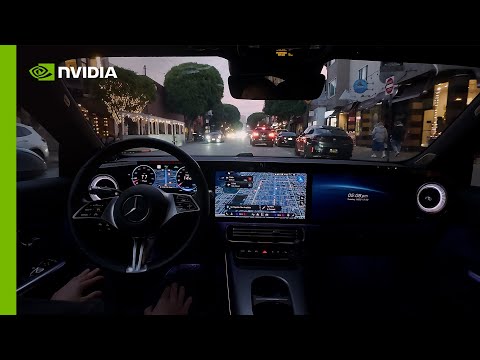
The company introduced the NVIDIA Alpamayo family of open AI models, simulation tools and datasets to support reasoning-based autonomous vehicle development.
Partnerships such as its collaboration with Mercedes-Benz, which is integrating NVIDIA DRIVE AV into new models, illustrate efforts to position its compute platform beyond traditional data centres.
Despite diversification, financial performance remains anchored in AI infrastructure demand. Hyperscale operators continue to expand GPU clusters for both training and inference, driving sustained capital expenditure on accelerated compute.
Although market reaction to the results was muted, with shares rising modestly, the revenue profile underscores the central role of data centres in NVIDIA’s growth. With over 90% of sales tied to that segment, the company’s trajectory remains closely aligned with global AI infrastructure deployment.
Company portals

Executives

Colette Kress
Executive Vice President and CFO
Jensen Huang
Founder and CEO