Behind the Floating Future of AI Data Centres
For years, the data centre industry has searched for spare land, bigger substations and faster routes to grid power.
Panthalassa’s answer is considerably more dramatic: head several hundred miles out to sea.
As AI infrastructure demand keeps surging, the sector’s hunt for energy is starting to resemble a global engineering competition.
Nuclear is back on the agenda, hyperscalers are investing in fusion start-ups and renewable developers are racing to secure generation capacity before the next wave of AI deployments arrives.
Now one company is arguing that the answer has been rolling across the ocean the whole time.
Oregon-based start-up Panthalassa believes floating, wave-powered data centres could help tackle one of the industry’s biggest problems: how to power AI workloads without adding even more strain to terrestrial grids.
The timing is significant. The International Energy Agency projects that energy consumption linked to AI will grow by around 30% annually through to 2030, when the technology could account for 3% of global electricity use.
That surge in demand has already pushed infrastructure providers towards increasingly unconventional ideas, from revived nuclear plants to satellite solar concepts and fusion investments.
Panthalassa’s may be among the boldest yet.
Named after the ancient superocean that once surrounded Pangea, the company recently raised US$140m in a funding round led by venture capitalist Peter Thiel, bringing its valuation close to US$1bn.
The round also attracted backing from Salesforce CEO Marc Benioff, PayPal and Affirm Co-Founder Max Levchin and investor John Doerr, whose previous investments include Google, Amazon and Uber.
Floating infrastructure for AI workloads
Panthalassa’s approach to data centre design is deliberately industrial rather than futuristic.
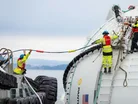
Its floating “nodes” are 85-metre steel structures that sit mostly beneath the ocean surface. Roughly the height of London’s Big Ben, the units generate electricity using the motion of waves pushing water through turbines housed within the structure.
That power is then used to run AI chips contained inside a hermetically sealed, seawater-cooled module. The system avoids many of the moving parts typically associated with marine engineering. There are no hinges, flaps or gearboxes, a design choice intended to reduce maintenance risks in harsh offshore environments.
Once deployed, the structures are towed horizontally out to sea before flipping upright and navigating using the hydrodynamic shape of their hulls.
Rather than connecting back to terrestrial telecoms or power networks, the floating data centres use a SpaceX Starlink satellite connection to handle AI queries and communications.
The result is a fully offshore compute platform designed to generate and consume power in the same location.
Why wave energy is attracting data centre interest
Garth Sheldon-Coulson, Panthalassa's Co-Founder and CEO, previously worked as an AI and energy researcher at hedge fund Bridgewater and has become one of the louder advocates for wave energy’s role in powering next-generation compute infrastructure.
"Energy from open-ocean waves is low-cost, sustainable, abundant and now we have the technology to make it accessible for people," Garth recently told the Financial Times.
The appeal is obvious for data centre operators. Unlike solar or wind generation, open-ocean wave patterns can offer more continuous energy production in deep-water environments far from coastal disruption.
Panthalassa argues that offshore deployment also avoids many of the challenges that have constrained earlier wave-energy projects, particularly the need for expensive seabed transmission infrastructure.
"The waves are like a battery for sunlight and we can be capturing from it 24/7," Garth adds.
The company believes wave and wind power, alongside nuclear and solar, are among the few clean energy sources capable of eventually supporting AI infrastructure at terawatt scale.
‘Go where the energy is’
What separates Panthalassa from conventional offshore renewable projects is that the company has no plans to transmit electricity back to shore.
Instead, it wants to move compute directly to the energy source itself.
The company’s slogan – “go where the energy is” – reflects a growing line of thinking emerging across the data centre sector as operators struggle with grid constraints and power shortages.
"One of the key insights that we had was that it's very important to use the electricity in place," Garth Sheldon-Coulson explained to the FT.
Panthalassa also changes the commercial model by eliminating the need for subsea transmission cables and large interconnector systems.
It also means that rather than selling energy, the company's commercial viability depends on selling compute capacity generated offshore.

Building the next phase
The newly raised capital will support construction of a pilot manufacturing facility in the US, with Panthalassa targeting initial commercial deployments next year.
According to the company, the nodes are built using “earth-abundant materials” such as steel, potentially easing pressure on already stretched rare earth and critical mineral supply chains tied to the energy transition.
Peter Thiel believes the project represents a major expansion of digital infrastructure beyond terrestrial limits.
"The future demands more compute than we can imagine. Extraterrestrial solutions are no longer science fiction. Panthalassa has opened the ocean frontier," he told the FT.
Whether floating AI infrastructure becomes mainstream remains uncertain.
But as hyperscale demand continues to test the limits of existing power systems, data centre operators are increasingly willing to explore concepts that once sounded implausible.
To learn more about hyperscale data centre strategies, join us at Exhibition White City in London on 20-21 May for Data Centre LIVE: The London Summit.
Attendees will gain practical insight from industry experts, hear real-world case studies and connect with peers and key decision-makers shaping the future of data centres.
Click here to sign up for these unmissable event tickets.
Company portals






Executives
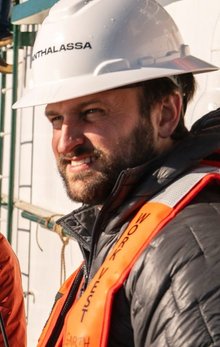
Garth Sheldon-Coulson
Co-Founder & CEO
Marc Benioff
Chair & CEO
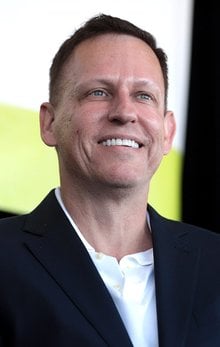
Peter Thiel
Co-Founder